
Users of dynopsi==1.0.0 start at MIGRATION.md.
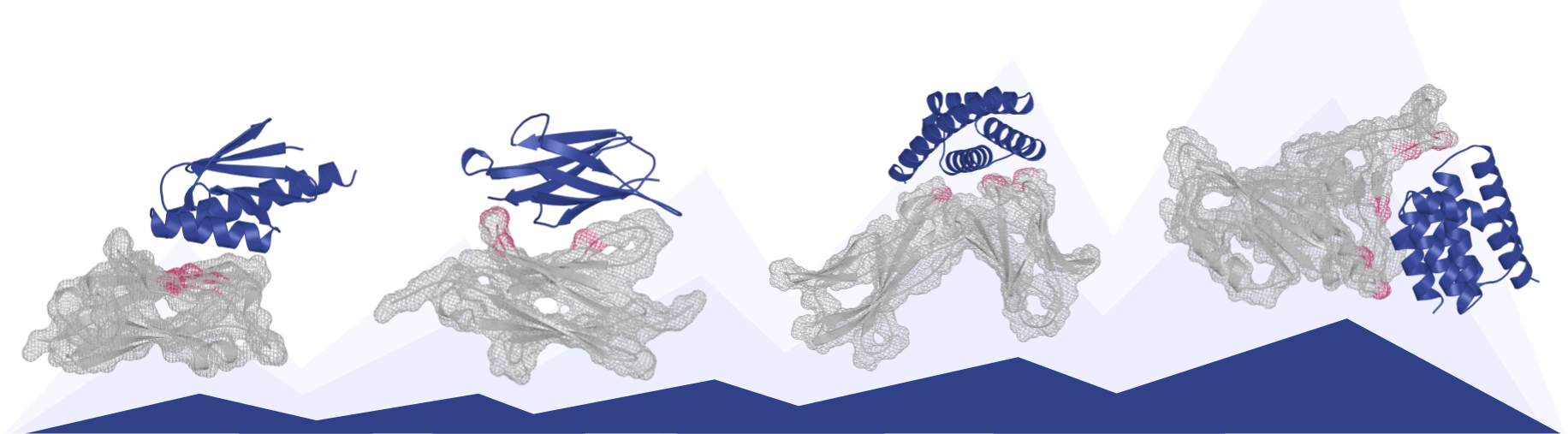
This repository enables inference and sampling for Cicada, the default Psi model (Psi-1.5 Cicada). Psi is a family of de novo miniprotein binder design models developed by Dyno Therapeutics. The binder design pipeline is configurable and modular, supporting binder generation against both single and multi-chain targets. Backbone atom coordinates are output for each designed binder and can be exported in multiple formats for downstream analysis. ProteinMPNN is recommended to generate accompanying sequences, and recommended settings are provided below in the sequence design section.
dynopsi 2.0.0 is the package; the default model is Psi-1.5 Cicada. Psi-1 remains checkpoint: v1. See Checkpoints.
Psi model checkpoints and supplementary datasets are hosted on Hugging Face

- Python 3.12 (
>=3.12,<3.13) - CUDA-enabled GPU
pip install dynopsi==2.0.0Download the versioned example configuration used by the CLI commands below:
curl --fail --location \
    --output il7ra_3di3_config.yaml \
    https://raw.githubusercontent.com/dynotx/dynopsi/v2.0.0/example/configurations/il7ra_3di3_config.yaml
An unpinned install in Python 3.12 upgrades to 2.0.0 and changes the default weights to Cicada. Version 1.0.0 runs on Python 3.10; pin dynopsi==1.0.0 there to keep it.
A binder design run is defined by a configuration, specified as a YAML file or directly in Python. The example below demonstrates both options, and a more detailed explanation of possible configurations can be found in example/README.md. The configuration contains sections for defining featurization parameters (e.g. binder lengths, target crops, hotspot residues), simulation parameters (e.g. ODE/SDE solvers, time schedules), and output formats and file locations. The input features to the model defined by the configuration can be viewed and validated before starting sampling. Generated structures can be used as the inputs to subsequent sequence design and filtering steps (performed outside of this package).
Each step is described in more detail in the sections below:
The design pipeline consists of three separately configurable components, which you can choose to configure as a YAML file or directly in Python. These are (1) Featurization, (2) Simulation, and (3) Output Configuration.
This is where you provide a target, optionally crop your target, and specify hotspots. For the target, you can provide either an RCSB record ID, an AFDB ID, or a local path to a structure file. For the first two options, the structure will be downloaded. For binder chains to be designed, you must specify the desired length (or multiple lengths) and how to place the binder center of mass, either a coordinate you supply or an estimator from the hotspot geometry. There is no default center. The examples use a coordinate you pick in a viewer such as PyMOL. See Binder center of mass.
name: A user-readable name that defines this featurization setup.- Define your target structure with exactly one of the following:
rcsb_record_id: The RCSB ID of your target; it will be downloaded from the RCSB PDB. This requires an internet connection.afdb_uniprot_id: The Uniprot ID of the target; it will be downloaded from AFDB (v6). All isoforms are allowed (e.g. P16871, P16871-2). This requires an internet connection.structure_path: Local path to the target structure, in .pdb or .mmcif format.
- Define the chain ID / indexing strategy used for the featurization specification
-
index_type: Which index strategy is used. Options areoriginal_residue_index,auth_residue_index, described below:auth_residue_index: Use the Author-defined indexing: residue indices and chain IDs are defined by the author of the deposited structure file.original_residue_index: chains are labeled A, B, C, … and each chain's residues start at 1.
We recommend loading your structure in Mol*Viewer to select chains and indices. Mol*Viewer explicitly annotates with "AUTH" in scenarios where the author-defined chain ID and residue indexing diverges from
original_residue_index.It is strongly recommended that you check the output featurization before generating designs to make sure that you have defined the correct chain/index parameters, especially if you use
auth_residue_index.
-
Four additional featurization arguments: crops, hotspots, new_chains_lengths, and new_chains_centers_of_mass. Omit crops to use the whole structure; the other three must be non-empty. Each accepts multiple configurations. Their Cartesian product yields one featurization per combination, and each combination is simulated sequentially.
crops: A dictionary of {crop_name : crop_range}.hotspots: A dictionary of {hotspot_name : hotspot_positions}.new_chains_lengths: A list of different chain lengths to generate.new_chains_centers_of_mass: A dictionary of {center_name : center_of_mass_function}.
The same binder design task can be specified using either YAML or Python.
YAML version:
featurization_pipelines:
    il7ra_3di3_binder_design:  # name this something unique
        type: dynopsi_binder_design_featurization_pipeline  # this is the only option currently supported
        index_type: auth_residue_index  # `auth_residue_index` or `original_residue_index`
        rcsb_record_id: 3di3
        # afdb_uniprot_id: P16871
        # structure_path: /path/to/pdb_or_cif/file
        crops:
            crop_17_209: B17-209  # name crop_17_209 can be whatever you want
        hotspots:
            hotspot_58V_80L_139Y: B58,B80,B139  # name hotspot_58V_80L_139Y can be whatever you want
        binder_atoms_to_include: bb
        design_conditioning:
            chain_is_loopy:
                non_loopy: NON_LOOP
            has_homooligomer_partner:
                no_partner: NO_PARTNER
        new_chains_lengths: [60, 80, 100, 120] # produce binders of length 60, 80, 100, 120
        new_chains_centers_of_mass:
            il7center:  # name il7center can be whatever you want
                type: predefined_center_of_mass
                centers_of_mass: [[28.1, 41.4, 47.9]]
Python version:
from dynopsi.data.constants import AtomFilter, DSSPLoopFeature, HomooligomerPartnerFeature
from dynopsi.data.featurization import DynoPsiBinderDesignFeaturizationPipeline, primitives

featurization_pipeline = DynoPsiBinderDesignFeaturizationPipeline(
    name="il7ra_3di3_binder_design",
    binder_atoms_to_include=AtomFilter.BB,
    index_type="auth_residue_index",
    rcsb_record_id="3di3",
    crops={"crop_17_209": "B17-209"},
    hotspots={"hotspot_58V_80L_139Y": "B58,B80,B139"},
    design_conditioning={
        "chain_is_loopy": {"non_loopy": DSSPLoopFeature.NON_LOOP},
        "has_homooligomer_partner": {"no_partner": HomooligomerPartnerFeature.NO_PARTNER},
    },
    new_chains_lengths=[60, 80, 100, 120],
    new_chains_centers_of_mass={
        "il7center": primitives.PredefinedCenterOfMassEstimator(centers_of_mass=[[28.1, 41.4, 47.9]])
    },
)
The loop label (chain_is_loopy) accepts NON_LOOP, LOOP_OR_OTHER, and MASK_OR_MISSING. The homooligomer-partner label (has_homooligomer_partner) accepts NO_PARTNER, HAS_PARTNER, and MASK_OR_MISSING. MASK_OR_MISSING is the mask (unspecified), not a fold or oligomeric state. For Cicada, the example uses the non-loop, no-partner values, a recommended starting point. Names under each key, such as non_loopy, are labels you choose. il7ra_3di3_loop_conditioning_config.yaml sets LOOP_OR_OTHER with NO_PARTNER.
Place the binder center with one of these types. L is the binder length in residues. The outward axis, used by the radius-of-gyration type, runs from the mean of the hotspot Cα together with resolved target Cα within 12 Å of the hotspot, through the hotspot mean.
predefined_center_of_mass: the coordinate you supply is the center. The PyMOL recipe is Choosing a binder center of mass.sphere_exclusion: the center is placed from the hotspot geometry. The target standoff from hotspot Cα, in angstroms, isD* = 2.2 · L^0.38 + 1.7 + exclusion_offset. The placed center stays at leastR_exclfrom resolved target Cα.R_exclequalsD*unless you setexclusion_radius.exclusion_offsetandexclusion_radiusare optional.estimate_binder_center_of_mass_radius_of_gyration: the center sits on the outward axis,2.11 · L^0.37 + 3.65angstroms from the hotspot mean, clipped topower_law_min_val–power_law_max_val(5–30 Å by default). That distance estimates the binder radius of gyration. Optional overrides arepower_law_scale,power_law_exponent,power_law_offset,power_law_min_val, andpower_law_max_val. Thetypeline alone is a complete entry.
new_chains_centers_of_mass:
    excluded:
type: sphere_exclusionThe simulation configuration controls the sampler, including which solver to use (ODE/SDE) and its parameters. Beyond the default solvers, sampling behavior can be customized by composing Ops — instructions that define the denoising trajectory — into a Simulation procedure. For miniprotein binder design, we recommend the following defaults:
YAML version:
simulation_pipelines:
    sde_default:  # name this whatever you want
        type: sde_simulation  # supported types include `ode_simulation` and `sde_simulation`
        time_sampler:
            type: linear_time_sampler  # supported types include `linear_time_sampler` and `log_time_sampler`
            num_steps: 60
        self_conditioning_mode: previous_step
        diffusion_coefficient_fn:
            type: inverse_parameter
            eps: 0.01
            clamp_max: 10.0
        noise_scale_fn:
            type: constant
            constant: 0.3
        ode_warmup_score_scale_fn:
            type: constant
            constant: 1.0
        ode_warmup_max_t: 0.30
        ode_cooldown_score_scale_fn:
            type: constant
            constant: 1.3
        ode_cooldown_min_t: 0.87
Python version:
from dynopsi.model.model_config import resolve_checkpoint
from dynopsi.simulation import LinearTimeSampler, SDESimulation
from dynopsi.utils import ConstantFunction, InverseParameterFunction

simulation = SDESimulation(
    name="sde_default",
    inference_model_config=resolve_checkpoint("v1.5-cicada"),
    time_sampler=LinearTimeSampler(num_steps=60),
    self_conditioning_mode="previous_step",
    diffusion_coefficient_fn=InverseParameterFunction(eps=0.01, clamp_max=10.0),
    noise_scale_fn=ConstantFunction(constant=0.3),
    ode_warmup_score_scale_fn=ConstantFunction(constant=1.0),
    ode_warmup_max_t=0.30,
    ode_cooldown_score_scale_fn=ConstantFunction(constant=1.3),
    ode_cooldown_min_t=0.87,
)The sampler fields above are the defaults for Psi-1.5 Cicada (v1.5-cicada, file dynopsi-1.5-cicada.ckpt). Sampling with Cicada requires a loop label (chain_is_loopy) and a homooligomer-partner label (has_homooligomer_partner); you set both, as in the featurization example. If you set neither checkpoint: nor --checkpoint, the run uses v1.5-cicada.
Psi-1 (v1, file dynopsi-1.ckpt) is the previous checkpoint. Set checkpoint: v1 or pass --checkpoint v1. That checkpoint needs self_conditioning_mode: same_timestep, num_steps: 100, and ode_warmup_max_t: 0.10. Psi-1 has no loop or homooligomer-partner conditioning, so omit design_conditioning. The 1.0.0 reproduction is Change 2.
If you set both checkpoint: and --checkpoint, they must name the same weights. A YAML file cannot set inference_model_config; name the weights with checkpoint: there. In Python, pass inference_model_config or a checkpoint request, not both. To build the config yourself:
from dynopsi.model.model_config import resolve_checkpoint

inference_model_config = resolve_checkpoint("v1.5-cicada")
DynoPsi supports only its published v1.5-cicada and v1 checkpoint short names. Each name resolves to an immutable Hugging Face revision, and the downloaded file must match its published SHA-256 before loading. Arbitrary repositories, files, and revisions are rejected.
Set formats, the output directory, and whether to save the full sampling trajectory. The recommended list is formats: [mmcif, npz]. mmcif is a structure file written as .cif, and pdb is written as .pdb. npz is a structure archive and can accompany either structure format. formats: [pdb, npz] is still valid.
Saving trajectories requires significantly more time and disk space and is not recommended for large-scale runs.
YAML version:
output_specifications:
    default_output_specification:
        output_dir: /path/to/outputs
        formats: [mmcif, npz]
        save_trajectory: False
Python version:
from dynopsi import OutputSpecification

output_specification = OutputSpecification(
    output_dir="./example/output",
    formats=["mmcif", "npz"],
    save_trajectory=False,
)Combine the pieces you specified above into a design pipeline.
YAML version:
design_pipelines:
    il7ra_3di3_binder_design:
        featurization_pipeline: il7ra_3di3_binder_design
        simulation_pipeline: sde_default
        output_specification: default_output_specification
Python version:
from dynopsi import DesignPipeline

design_pipeline = DesignPipeline(
    name="dynopsi_binder_design_pipeline",
    featurization_pipeline=featurization_pipeline,
    simulation_pipeline=simulation,
    output_specification=output_specification,
)The dynopsi CLI command only supports calls to .yaml configurations, with examples shown below. If you prefer to run design pipelines via Python scripts, refer to the .ipynb examples in example/notebooks/ for a starting point to define your own script.
Dry run the design specification and verify that the solver configuration is valid. It is strongly recommended to run this validation and inspect your featurization, especially before long sampling runs.
Optional Arguments:
--format: File format for the featurization preview written bydynopsi check. Accepted values arepdbandcif; the default ispdb. Sampling output formats are configured separately in the YAML output specification.--overwrite: Replace an existing/path/to/outputs/<design_pipeline_name>/verify_configurationdirectory. Without this flag,dynopsi checkexits if that directory already exists.--checkpoint: Published checkpoint short name. If omitted, the checkpoint comes from the YAML configuration or defaults tov1.5-cicada.
CLI + YAML version:
dynopsi check il7ra_3di3_config.yamlPython version:
design_pipeline.verify_configuration()View the featurization configuration (path below) in a structure viewer. Color by b-factor; this will show
| B Factor | Hotspot Feature |
|---|---|
| 100 | hotspot |
| 50 | binder (center of mass) |
| 0 | other target residues |
/path/to/outputs/
└── <design_pipeline_name>/
    └── verify_configuration/
        └── 3di3___crop_17_209___hotspot_58V_80L_139Y___length_<length>_il7center___non_loopy___no_partner___atoms_bb___features.pdb
Optional arguments
--num_samples: Number of designs generated for each combination in the Cartesian product; the default is10.--overwrite: Replace an existing/path/to/outputs/<design_pipeline_name>/<simulation_name>directory. Without this flag,dynopsi sampleexits if that directory already exists.--batch_size: Batch size for inference. If omitted, it is inferred from memory on the single sampling device (cuda:0when CUDA is available, otherwise CPU):5for at least 80 GB,2for at least 40 GB, and1otherwise.--checkpoint: Published checkpoint short name. If omitted, the checkpoint comes from the YAML configuration or defaults tov1.5-cicada.
CLI + YAML version:
dynopsi sample il7ra_3di3_config.yaml --num_samples 10Python version:
design_pipeline.sample(num_samples=10)With formats: [mmcif, npz] and save_trajectory: False, the example writes a resolved configuration alongside one directory per featurization. The featurization directory name joins the structure, crop, hotspot, length, center, conditioning labels, and atom set with ___:
/path/to/outputs/
└── <design_pipeline_name>/
    └── <simulation_name>/
        ├── resolved_design_config.json
        └── 3di3___crop_17_209___hotspot_58V_80L_139Y___length_<length>_il7center___non_loopy___no_partner___atoms_bb/
            ├── X_T_final_state_<sample_idx>.cif
            ├── X_T_final_state_<sample_idx>.npz
            └── observable_outputs_<sample_idx>.npz
X_T_final_state_<sample_idx>.npz is the final structure archive. observable_outputs_<sample_idx>.npz stores the sampler tensors recorded during inference, with arrays keyed by state, step, and modality.
When save_trajectory is True, that directory also contains X_T_trajectory_<sample_idx>.cif and X_T_trajectory_<sample_idx>.npz.
Cicada generates backbone (N, CA, C, O) coordinates for the binder, and preserves the original target sidechains. We recommend designing the binder sequence with target-aware ProteinMPNN.
ProteinMPNN's single-structure input requires a PDB file, so set formats: [pdb, npz] for this sampling run or convert the generated CIF to PDB first. Replace the path and binder chain ID below with values for your design. --pdb_path_chains "B" designs chain B while holding the other chains fixed. The low sampling temperature favors designability over diversity.
python protein_mpnn_run.py \
    --model_name v_48_020 \
    --sampling_temp 0.0001 \
    --backbone_noise 0.0 \
    --omit_AAs C \
    --num_seq_per_target 4 \
    --use_soluble_model \
    --pdb_path_chains "B" \
    --pdb_path "/path/to/dynopsi_design.pdb" \
    --out_folder "/path/to/proteinmpnn_outputs"
To preserve selected positions in the designed binder chain, also pass --fixed_positions_jsonl. ProteinMPNN expects one JSON object per line, keyed by the PDB file stem and then the designed chain, for example {"dynopsi_design": {"B": [1, 2, 3]}} for /path/to/dynopsi_design.pdb.
We strongly recommend that you refold designs with AlphaFold2 (AF2) and filter on binder and interface quality metrics. The white paper shows filtering results from refolding with AF2 monomer in initial guess mode with a target template provided and 3 recycles. The designed structures are compared to the refolded structures, and designs that satisfy the following constraints are retained.
- Binder RMSD (designed complex vs. refolded complex) < 1 Angstrom
- Binder pLDDT > 0.8
- Inter-chain pAE (ipAE) < 10
The filter thresholds match the binder design in silico benchmarking thresholds from Watson, Juergens, Bennett (2023).
The code below shows refolding with ColabDesign. Replace the paths, chain IDs, and sequence with values for your design. Applying the Binder RMSD threshold additionally requires aligning the designed and refolded binder coordinates, for example with the Kabsch algorithm; that alignment is not shown here.
from colabdesign.af import mk_afdesign_model

design_pdb = "/path/to/dynopsi_design.pdb"
target_chain_id = "A"
binder_chain_id = "B"
binder_sequence = "REPLACE_WITH_BINDER_SEQUENCE"

complex_prediction_model = mk_afdesign_model(
    protocol="binder",
    num_recycles=3,
    data_dir="/path/to/alphafold_weights",
    use_multimer=False,
    use_initial_guess=True,
    use_initial_atom_pos=False,
)

complex_prediction_model.prep_inputs(
    pdb_filename=design_pdb,
    target_chain=target_chain_id,
    binder_chain=binder_chain_id,
    use_binder_template=False,
    rm_target_seq=False,
    rm_target_sc=False,
    rm_template_ic=True,
)

models = ["model_1_ptm"]

complex_prediction_model.predict(
    seq=binder_sequence,
    models=models,
    num_models=len(models),
    sample_models=False,
    num_recycles=3,
    verbose=False,
)This package is released under the Apache License 2.0. See LICENSE/, including LICENSE/NOTICE and LICENSE/THIRD-PARTY-NOTICES.
Cite the white paper.