
Open-source lip-sync in the spirit of FaceFX: voice recording + transcript → animation curves that drive a character's face.


Each mouth frame above is the dominant viseme of a real track.json the pipeline generated from that sentence — no ML, just deterministic phoneme→viseme→curve math.
▶ Live demo · 🔊 Hear it (real speech, mouth synced to audio) · Read the docs →
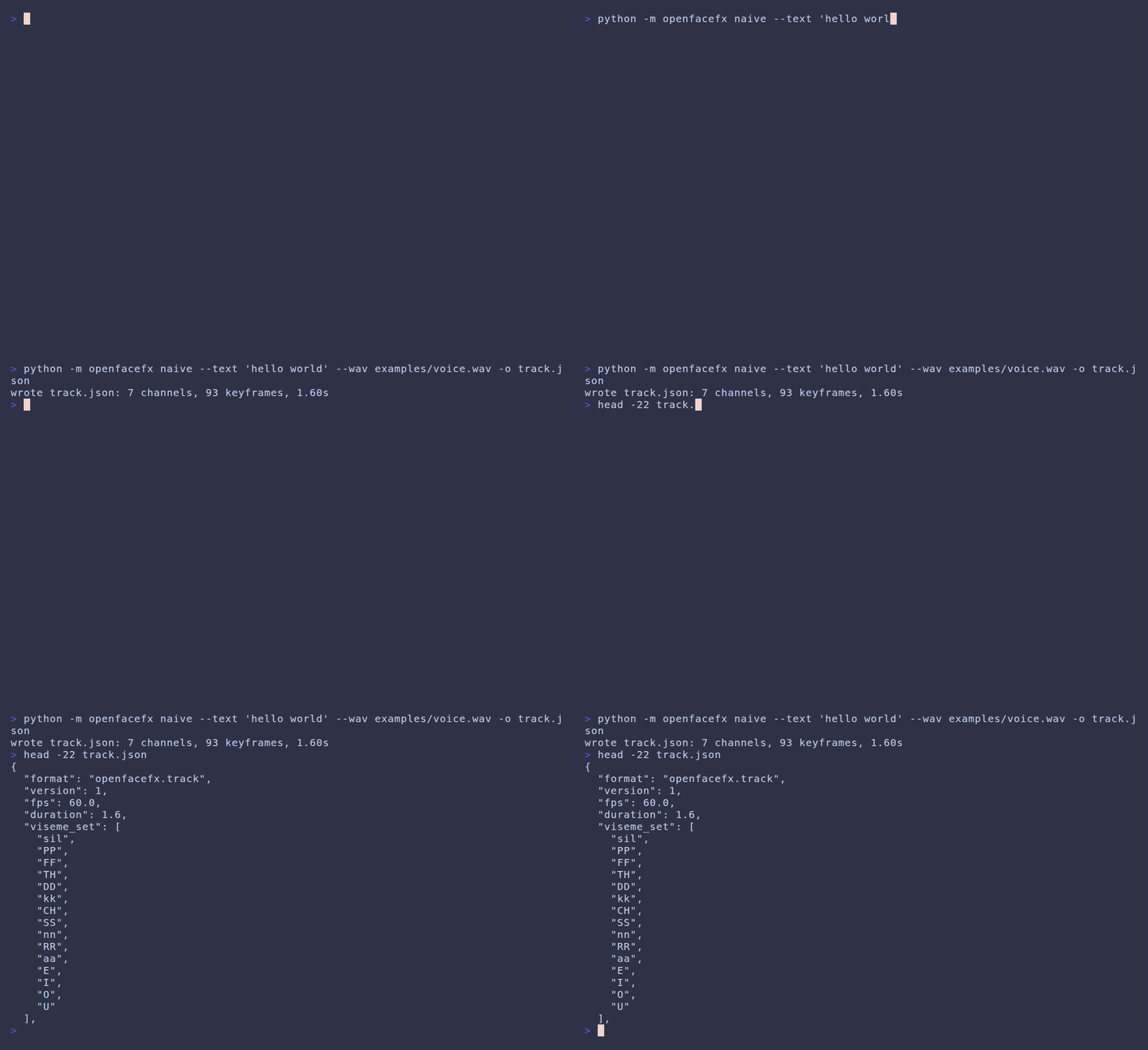
The one-command quickstart, rendered from docs/quickstart.tape by VHS in CI on every push — recorded as code, so it can't drift from the real CLI. Open the live previewer →
pip install openfacefx # numpy is the only runtime dependencyOr from source, to contribute:
git clone https://github.com/OpenFaceFX/OpenFaceFX && cd OpenFaceFX
pip install -e .No models, no downloads — approximate lip-sync from text + a WAV's duration:
python -m openfacefx naive --text "hello world" --wav examples/voice.wav -o track.jsonwrote track.json: 7 channels, 93 keyframes, 1.60s
track.json is the openfacefx.track format: sparse [time, value] keyframes
per viseme channel, weights in [0, 1]. The real output begins:
{
  "format": "openfacefx.track",
  "version": 1,
  "fps": 60.0,
  "duration": 1.6,
  "viseme_set": [
    "sil",
    "PP",
    "FF",
    "TH",
    "DD",
    "kk",
    "CH",
    "SS",
    "nn",
    "RR",
    "aa",
    "E",
    "I",
    "O",
    "U"
  ],
  "channels": [
    {
      "name": "sil",
      "keys": [
        [
          0.0,
          0.6196
        ],
The first 30 lines of the actual file (7 channels, 93 keyframes in full). A reference reader is ~15 lines — see docs/COMPATIBILITY.md.
15 targets from the Oculus/Meta LipSync convention — a well-documented, IP-free
set most character rigs already expose blendshapes for. Each mouth shape below
is drawn by the same schematic articulator the live previewer
animates, rendered at full weight (regenerate with python tools/render_viseme_gallery.py):
| Viseme | Shape | Phonemes | Mouth |
|---|---|---|---|
| sil |  |
— | neutral / mouth at rest |
| PP |  |
B, M, P |
lips pressed shut |
| FF |  |
F, V |
lower lip to upper teeth |
| TH |  |
DH, TH |
tongue between the teeth |
| DD |  |
D, L, T |
tongue to the alveolar ridge |
| kk |  |
G, HH, K |
back of tongue raised |
| CH |  |
CH, JH, SH, ZH |
rounded, protruded |
| SS |  |
S, Z |
narrow, teeth close |
| nn |  |
N, NG |
nasal, tongue up |
| RR |  |
ER, R |
retroflex / lightly rounded |
| aa |  |
AA, AE, AH, AY |
open jaw |
| E |  |
EH, EY, IH |
mid-front spread |
| I |  |
IY, Y |
wide spread |
| O |  |
AO, AW, OW, OY |
rounded and open |
| U |  |
UH, UW, W |
tight lip rounding |
To retarget to a different rig (Apple ARKit's 52 blendshapes, a Preston-Blair
12-shape set, …), edit PHONEME_TO_VISEME and VISEMES in visemes.py —
nothing else changes.
FaceFX-style tools are really four subsystems chained together. Only the first (acoustic alignment) needs a heavy model — and excellent open-source aligners already exist. So OpenFaceFX wraps the aligner instead of reinventing it, and fully owns the other three stages:

- Alignment — time-stamped phonemes from Montreal Forced Aligner (parser included), or a dependency-free naive aligner for instant prototyping.
- Phoneme → viseme — the widely-adopted Oculus/Meta 15-viseme convention.
- Coarticulation — Cohen–Massaro dominance blending, so mouth shapes flow into each other instead of switching.
- Keyframe reduction — Ramer–Douglas–Peucker thinning into sparse, engine-friendly curves.
Every seam is a tiny data contract (PhonemeSegment in, FaceTrack out), so
any stage can be swapped without touching the rest.
Accurate lip-sync from a Montreal Forced Aligner result:
# 1. run MFA (separately) to get voice.TextGrid, then:
python -m openfacefx mfa --textgrid voice.TextGrid -o track.json
Straight from a TTS engine's own timing — skip the aligner (espeak/MBROLA
.pho, Piper, or Cartesia phonemes; Azure or Polly visemes; details and
capture scripts in docs/timing.md):
python -m openfacefx from-timing --file visemes.json --format azure -o track.jsonOr pin the naive aligner at known word/segment boundaries — subtitle cue times or
TTS word timestamps (SRT, Azure/ElevenLabs/Kokoro/Google) — for much better sync
with no models (SRT supplies its own transcript; the rest take --text):
python -m openfacefx naive --anchors cues.srt --anchors-format srt --wav voice.wav -o track.jsonNo transcript at all? Drive the mouth straight from audio loudness — an amplitude fallback in the spirit of SALSA/Moho/Live2D (energy, not viseme detection; good for barks, crowds, or a quick pass when all you have is a WAV):
python -m openfacefx energy --wav examples/voice.wav -o track.jsonStraight to a Unity AnimationClip, or remapped onto another rig:
python -m openfacefx naive --text "..." --wav voice.wav -o clip.anim   # viseme_* curves
python -m openfacefx naive --text "..." --wav voice.wav -o clip.anim --anim-naming vrchat
python -m openfacefx mfa --textgrid voice.TextGrid -o track.json --retarget arkit
Or a stepped cue list for the indie 2D ecosystem — Rhubarb TSV/XML/JSON,
Moho/OpenToonz .dat (Preston-Blair drawing names), Papagayo .pgo — flattened
to the dominant mouth shape per interval (extension picks the format; .json
stays the native track, so ask for the Rhubarb JSON explicitly):
python -m openfacefx naive --text "..." --wav voice.wav -o cues.tsv          # Rhubarb TSV
python -m openfacefx mfa --textgrid voice.TextGrid -o mouth.dat              # Moho/OpenToonz
python -m openfacefx mfa --textgrid voice.TextGrid -o cues.json --cue-format json-cues
Or bake into a VTuber/game engine's own animation asset — a Live2D Cubism
motion3.json (a single mouth-open parameter curve by default, or per-vowel
ParamA/I/U/E/O via --live2d-params, or read the target from a model's
model3.json LipSync group) and a Godot 4 AnimationPlayer resource (.tres,
one blendshape value track per viseme, --godot-node/--godot-naming):
python -m openfacefx naive --text "..." --wav voice.wav -o mouth.motion3.json  # Live2D Cubism
python -m openfacefx mfa --textgrid voice.TextGrid -o lipsync.tres            # Godot 4
Whole dialogue trees at once, with an OOV/confidence QA report and incremental re-runs:
python -m openfacefx batch --dir voice/ --out tracks/ --recurse --modified-only --jobs 8For dialogue-scale runs, --machine-readable streams a live NDJSON progress log,
--ledger keeps an append-only run trail, and --cue-warnings ranks cue
outliers — see Batch runs.
Or drive the batch from a localization string table with
--manifest loc.csv (one row per line, keyed by loc-ID) instead of a file tree —
see Loc-table manifests.
Weighted many-to-many phoneme mapping and coarticulation timing are
data/parameters, not code — see examples/mappings/ and CoartParams.
JALI-style artistic dials tune articulation strength without retiming: --intensity
(master, <1 mumbles, >1 hyper-articulates) and repeatable --gain class=value
(e.g. --gain tongue=0.6 --gain jaw=1.2); all 1.0 is a byte-identical no-op.
Named --style presets bundle those dials into a delivery style — neutral
(the defaults, byte-identical), whisper, mumble, tense, exaggerated,
broad — and explicit --intensity/--gain still compose on top. --stress-emphasis
[AMOUNT] articulates lexically stressed syllables more strongly: it biases
ARPABET primary/secondary-stressed vowels up and unstressed ones down (via the
dominance blend, so each frame still sums to ~1 and lip closures still seal). Off
by default; a no-op on inputs without stress digits (STYLE_PRESETS,
style_params, CoartParams.stress_emphasis for library callers).
JALI coarticulation rules (SIGGRAPH 2016)
extend the component model with a data-driven rule table — opt-in behind
CoartParams(jali=True), and byte-identical to the legacy path when off. It
adds JALI's hard constraints (bilabial/labiodental closure, sibilants narrow the
jaw, non-nasals open the lips), its habits (duplicated-viseme merge across word
boundaries — "po_p m_an"; lip-heavy visemes UW/OW/OY/w/S/Z/J/C start early and
hold longer; a tongue articulation never pulls the lips; a short obstruent/nasal
leaves the jaw untouched; a word-final lip shape anticipates), and an empirical
per-phoneme onset/decay lookup (post-pause vs post-vowel onsets, ~150 ms
lip-protrusion extension) in place of the per-class timing constants. The rules,
category phoneme sets and timing constants live in data/jali_rules.json (plain
data, so new measurements drop in) and each is individually toggleable via
jali_rules (JALI_RULE_IDS lists them). A custom mapping can also give a target
NVIDIA-A2F-style gain/offset to scale/bias a channel (chiefly the tongue) —
mapping schema v2 (#53); version-1 files still load, the absent fields reading
as the no-op defaults.
FaceFX-style post-solve curve conditioning smooths and retimes the curves
without re-solving: --smooth SECONDS runs a temporal Gaussian (sigma in
seconds) over the dense curves before keyframe reduction to soften jitter — lip
closures are re-sealed after the filter, so /p/ /b/ /m/ /f/ /v/ stay sharp
— and --lag MS slides every viseme curve to trail (>0) or lead (<0) the
audio, clamped into the clip. Both default off (byte-identical) and apply to
naive/mfa/from-timing/energy.
When retargeting, trim individual rig shapes without forking a preset table:
--adjust adjust.json applies a per-target clamp(gain*v + offset, 0, 1) (JSON
{"jawOpen": {"gain": 0.8}, "mouthSmileLeft": {"offset": 0.15}} — soften the
jaw, hold a smile slightly on), and --retarget-shapes shapes.json restricts a
preset to a rig's real shapes (a JSON array), rerouting any it lacks through the
preset's fallback table (e.g. a tongue-less ARKit rig). Both leave the weighted
tables untouched; details in docs/retargeting.md.
Library use:
from openfacefx import generate_naive, load_mfa_textgrid, generate_from_alignment, write_json

track = generate_naive("the quick brown fox", duration=1.8)      # quick path
# or, accurate:
segs  = load_mfa_textgrid("voice.TextGrid")
track = generate_from_alignment(segs)
write_json(track, "track.json")A mouth that moves but a face that's otherwise frozen reads as a mask. Pass
--gestures to layer the other channels a believable performance needs — eye
blinks, eyebrow raises, head nods and idle sway, and gaze saccades — on top of
any generated track (issue #5):
python -m openfacefx naive --text "..." --wav voice.wav --gestures -o track.json
python -m openfacefx mfa   --textgrid voice.TextGrid       --gestures -o track.json
python -m openfacefx energy --wav voice.wav                --gestures -o track.json
The timing is coupled to the speech the way FaceFX/JALI/SmartBody do it, not
sprinkled at random: blinks follow a Poisson process (~15/min) but snap onto
pauses and stressed syllables, with a biphasic fast-close/slow-open lid;
eyebrow flashes and head nods fire on loudness peaks (the same energy.py
envelope the audio fallback uses) and primary-stress vowels; a slow sum-of-sines
keeps the head alive between nods. Everything is deterministic — seeded from
--gesture-seed (default 0), identical keyframes every run and across Python
versions — and fully opt-in: without --gestures, output is byte-identical
to before. Tune it with --blink-rate (blinks/min) and --no-brows, or the
GestureParams dataclass in the library.
Blink and brow channels are [0,1] blendshape weights (like the visemes);
headPitch/Yaw/Roll and eyePitch/Yaw are signed pose channels in degrees
(positive headPitch = down, positive eyeYaw = the subject's left), or a
signed [-1,1] range with GestureParams(head_eye_in_degrees=False). They are
not visemes: --retarget passes them through unchanged, and the mouth-only cue
(.tsv/.dat/…) and Bethesda .lip exporters ignore them.
from openfacefx import generate_from_alignment, GestureParams, load_mfa_textgrid

segs  = load_mfa_textgrid("voice.TextGrid")
track = generate_from_alignment(segs, gestures=GestureParams(seed=0), wav="voice.wav")
# or add gestures to an existing track: add_gestures_to_track(track, dur, times, env, segs)A track says how the face moves; an event says what happened and when — a
named, timed, typed record with a freeform JSON payload that a game runtime turns
into gameplay (play a sound, shake the camera, fire a Blueprint node). It is the
same payload-only model as FaceFX events, Unreal's AnimNotify and Unity's
AnimationEvent (issue #6).
The layer is additive: without it, every track is byte-identical to before.
Pass --events to auto-author a typed layer from the speech itself — emphasis
events on stressed syllables / loudness peaks and phrase boundary markers at
pauses (reusing the same accent detection as --gestures, but independent of it):
python -m openfacefx naive --text "..." --wav voice.wav --events -o track.json
python -m openfacefx mfa   --textgrid voice.TextGrid       --events -o track.anim
Takes are deterministic variation. Author weighted alternative event-sets per
group; a line id picks one, forever, by hashing the id with SHA-256 (no RNG,
no wall-clock — the same id resolves to the same take on every machine and Python
version; the builtin hash() is deliberately not used because it is salted):
from openfacefx import (generate_from_alignment, load_mfa_textgrid,
                        Variants, VariantGroup, Alternative, Event, resolve)

track = generate_from_alignment(load_mfa_textgrid("voice.TextGrid"))
track.variants = Variants("npc_greet_017", [
    VariantGroup("headgest", [
        Alternative(1.0, [Event(0.4, "gesture", "nod_small", payload={"intensity": 0.6})]),
        Alternative(2.0, [Event(0.4, "gesture", "nod_big")]),   # twice as likely
    ]),
])
events = resolve(track)     # same line id -> same pick, every run
Each group hashes independently, so a head-gesture choice and a gaze choice vary
independently for one line. On the command line, --events-file layer.json
attaches an authored events/variants block and --line-id ID bakes the chosen
take into concrete events on write.
Events serialize into the track JSON (an optional top-level events / variants
array — see Output format) and into Unity .anim
AnimationEvents: each event becomes an AnimationEvent Unity SendMessage-invokes
on the Animator's GameObject (OnFaceEvent by default), with the event name and
payload packed into its single stringParameter as name|{json}; ranged events
(dur > 0) expand to a _Begin/_End pair. For Unreal, write_unreal_notifies
emits an AnimNotify sidecar JSON that a short editor-Python snippet stamps onto a
UAnimSequence (point events → UAnimNotify, ranged → UAnimNotifyState); the
snippet ships in that module's docstring. The mouth-only cue/.lip exporters
ignore events.
Steer the generated animation with inline tags in the transcript — expression
curves, event notifies, local emphasis and audio chunking — the way FaceFX's
text-tagging stage
does. Tags are stripped before grapheme-to-phoneme conversion, the clean
words are lip-synced as usual, and each tag is mapped onto the timeline the
aligner produced. Turn it on with --tags (or just include a tag — clear tags
auto-enable it):
python -m openfacefx naive --tags --duration 3 -o out.track.json \
  --text 'I said [brow_raise type=ct v1=1]really[/brow_raise] loud [event:sound payload="clap"] now.'
The syntax is modelled on the FaceFX text-tag docs (and, for [emphasis] /
[pause], on SSML <emphasis> / <break>):
| Family | Syntax | Effect |
|---|---|---|
| Curve | [Name type=quad|lt|ct|tt v1=.. v2=.. v3=.. v4=.. easein=.. easeout=.. timeshift=.. duration=..]word(s)[/Name] |
adds an animation channel Name keyframed over the tagged word span (leading/centered/trailing triplet or quadruplet, 0.2 s ease default) |
| Event | [event:NAME k=v ...], [gesture:NAME ...], or FaceFX {"group|anim" start=.. payload=".." ...} |
injects an event at the start of the following word (end of the last word if trailing); start/duration/blendin/blendout map to event fields, everything else is kept in the payload |
| Emphasis | [emphasis]word[/emphasis] (optional strength=) |
raises the local vowel peak over the span (reuses the --stress-emphasis dominance pass from #18) |
| Chunk | <T> angle-bracket marker(s), e.g. <5>Yes I'm here<7.5> |
pins text to audio time T; the naive utterance is split into phrases with sil in the gaps. Times must be non-negative, <= duration and non-decreasing, else a ValueError |
| Pause / phrase | [pause:SECONDS] / [break time=..], [phrase] |
inserts that much silence at the word boundary; [phrase] drops a marker/phrase event |
Curve tags are still lip-synced (the word survives), event payloads round-trip
through the track JSON, and the tag layer composes with --gestures / --events
/ --prosody / --edits. A tagless transcript is byte-identical to a run
without --tags, so switching it on is safe.
Programmatically, parse_tagged_transcript(text) -> (clean_text, tags) exposes
the parse, and generate_naive(text, duration, parse_tags=True, preprocess=fn) runs an optional callable(text) -> text first — a registered
auto-tagger (regex head-shakes on no/not, phonetic respelling of proper nouns)
that injects a tag is identical to hand-writing it. Deterministic, stdlib-only
parsing (re / shlex). --tags is rejected with -o .lip (no curve/event
slot) and with --anchors.
Author already carrying SSML for
Azure / Google / Polly? Feed the same document in with --ssml (or just pass a
<speak> root — it auto-detects) and it drives lip-sync through a thin
front-end over the tags above — <break>→[pause], <emphasis level=..>→
[emphasis], <mark>/<p>/<s>→[phrase], <sub alias=..> substitutes the
spoken form, <say-as> normalizes its text:
python -m openfacefx naive --ssml --duration 3 -o out.track.json \
  --text '<speak>Say <emphasis level="strong">brave</emphasis> <break time="300ms"/> new world <mark name="beat"/></speak>'
It parses with the stdlib xml.etree, produces the same (clean_text, tags)
as the equivalent bracket transcript (so an SSML document is byte-identical to
the tagged one through the whole pipeline, and a construct-free <speak> is
byte-identical to plain naive --text), degrades unknown elements to their text,
and raises a clear ValueError on malformed XML. <phoneme ph=..> pronunciation
override is deferred to the i18n framework (#8). See the
SSML input reference;
parse_ssml(text) -> (clean_text, tags) is the library entry.
--events reads accents from the timing (stress digits, loudness peaks).
--prosody reads them from the pitch of the voice as well — a numpy
autocorrelation pitch tracker follows the fundamental frequency (F0), and where
pitch and loudness spike together you get an emphasis; a silent pause or the
end of the line is a phrase_boundary; a rising terminal F0 (the yes/no-question
cue) is a question_rise (issue #4).
It needs the audio, so pass --wav:
python -m openfacefx naive  --text "are you going" --wav voice.wav --prosody -o track.json
python -m openfacefx mfa    --textgrid voice.TextGrid --wav voice.wav --prosody -o track.anim
python -m openfacefx energy --wav voice.wav                          --prosody -o track.json
The events are ordinary Events, so they
ride the same JSON / Unity .anim / Unreal notify path and compose with
--events and --gestures (the audio-derived phrase_boundary sits happily
beside a timing-derived phrase). Library callers get prosody_events(wav, fps),
the prosody_features(wav) bundle (F0, voicing, loudness, speaking rate) and the
raw pitch_track(wav). It is fully deterministic (no RNG — identical events on
Python 3.9/3.13) and opt-in: without --prosody, output is byte-identical.
This is DSP, not an ML prosody model. Autocorrelation F0 is within a few
percent on clean voiced speech but makes octave errors and mislabels voicing on
whispered/breathy/creaky voice or low SNR, and it will misbehave on music,
background noise and overlapping speakers; prominence and question detection are
rule-based cue layers, not phonological labelling. That is fine here — the events
only need relative pitch movement to land in the right place, not calibrated Hz.
Input is 16-bit PCM WAV (convert first with ffmpeg -c:a pcm_s16le).
The pipeline is a pure function, so re-running it — to re-tune --intensity, a
--gain, the coarticulation, or a new alignment — throws away any manual tweak an
animator made to the curves. OpenFaceFX solves this the way FaceFX does, with a
two-layer ownership model (issue #9):
analysis owns the generated curves, and a user keeps their edits in a small,
separate sidecar *.edits.json — never inline, so the .track stays clean,
versioned interchange and version stays 1.
Capture what you changed by diffing a hand-edited track against the baseline it
came from, then apply the sidecar on any later run with --edits:
python -m openfacefx naive --text "..." --wav voice.wav -o base.json      # generate
#   ...an animator hand-edits base.json -> edited.json in a curve editor...
python -m openfacefx diff-edits base.json edited.json -o line.edits.json   # capture
python -m openfacefx naive --text "..." --wav voice.wav \
       --intensity 1.2 --edits line.edits.json -o final.json               # re-run, edits kept
Two per-channel modes mirror FaceFX's offset curve and owned-off editing:
offset(default) stores the delta from the baseline. Being relative, it rides on top of whatever the solver now produces — so an offset survives an intensity / gain / coarticulation change, which is the common case. The result isclamp(analysis + offset), exactly FaceFX's "virtual curve".replacestores absolute values (full manual ownership). Add--span T0 T1to lock only a time region: that window is user-owned and the freshly generated curve shows through everywhere else.
Conflicts are handled conservatively. An edit whose channel the regeneration
dropped (a renamed shape, or a word removed on re-alignment) is preserved and
reported by default (--on-conflict keep-edit — a hand-edit is never silently
lost); take-generated discards it for the fresh output instead. A locked region
always wins inside its span. Library callers get diff_edits(base, edited),
apply_edits(regenerated, edits) and load_edits/save_edits; the merge is
deterministic (numpy interp/clip + the same RDP thinner, no RNG — identical on
Python 3.9/3.13) and opt-in: without --edits, output is byte-identical.
The sidecar is plain JSON — a stable base_hash of the baseline for provenance,
source_id (optionally the audio's sha1, via diff-edits --source), and one
record per edited channel:
Out of scope (issue #9 keeps it numpy + stdlib, deterministic, non-ML): no Bezier/tangent handles (curves are linear by design), no phoneme-anchored rebase of edit times onto a changed transcript (offsets on the same audio are the supported robustness story; a transcript rewrite that drops a channel is flagged, not auto-migrated), and no 3-way / multi-user merge beyond keep / take.
Production rigs keep expression on a separate additive layer over lip-sync —
SALSA's EmoteR blends emphasis-timed emotes over speech, and Unreal additive
animation is the difference between a pose and a reference pose added onto the
base. OpenFaceFX does the same (issue #38):
an authored emotion envelope becomes a true additive delta channel_value - reference_value, baked onto the speech-solved channels with a global intensity
dial and per-channel clamps. Bake it over a solved track with the emotion
command:
python -m openfacefx naive --text "we did it" --duration 1.5 -o base.json
python -m openfacefx emotion base.json happy.emotion.json --intensity 1.0 -o baked.jsonAn envelope carries either direct emotion-channel keyframes (smile /
frown / brow_raise …) or a compact valence/arousal keyframe track (both in
[-1, 1]) mapped through a fixed, hand-authored table by bilinear
interpolation — high valence → smile + cheek raise, low valence + high arousal →
brow lower. It is a table lookup and interpolation, not ML; the neutral point
valence = arousal = 0 maps to an all-zero pose. The baked result is a normal
track that exports through every exporter (the mouth-only cue/.lip writers
ignore the expression channels, and --retarget passes them through). Library
callers get bake_emotion(track, envelope), va_to_pose(valence, arousal) and
load_envelope/save_envelope; the bake is deterministic (numpy interp/clip
- the same RDP thinner, no RNG — identical on Python 3.9/3.13) and opt-in:
with
--intensity 0, a neutral envelope, or a zero delta, output is byte-identical to the plain speech track. See docs/api/emotion.md for the full valence/arousal table.
OpenFaceFX writes stepped mouth-cue files for the indie 2D ecosystem — and now
reads them back (issue #44),
so a studio sitting on a Rhubarb/Papagayo library or a hand-timed Moho mouth
track has a migration path into the tool: import, then coarticulate,
retarget, layer gestures/events, condition and re-export to Unity/Godot/Live2D.
The from-cues command auto-detects the format by extension and first line:
python -m openfacefx from-cues mouth.tsv -o track.json # Rhubarb TSV/XML/JSON
python -m openfacefx from-cues mouth.dat --fps 24 -o track.anim # Moho/OpenToonz -> Unity
python -m openfacefx from-cues mouth.pgo --coarticulate -o track.json # Papagayo, smoothedEach parser is the verified inverse of the matching cue exporter: the shape
tables are derived from the same retarget presets the writers use, so
write → from-cues → write round-trips byte-identically for Rhubarb and to a
byte-exact fixed point (preserving the exact shape/frame sequence) for the
frame-based Moho .dat / Papagayo .pgo. The result is an ordinary stepped
FaceTrack (one [0,1] viseme channel, sil in the gaps) that flows through
every exporter and --retarget; --coarticulate re-solves the steps through the
dominance blend. Extended/unknown shapes route through the documented
RHUBARB_EXTENDED_FALLBACK or raise a clear error — never silently dropped.
Library callers get import_cues(path), detect_format, build_cue_track and
the RHUBARB_TO_VISEME / PRESTON_BLAIR_TO_VISEME tables; stdlib + numpy,
deterministic, and purely additive (no existing output changes). See
docs/api/importers.md.
The sibling from-csv command imports blendshape-weight CSV (issue
#45) — the OpenFaceFX long
time,channel,value format (exact inverse of write_csv) or a wide per-frame
Apple ARKit / Epic Live Link Face export (row = frame, columns = blendshape
names, optional Timecode):
python -m openfacefx from-csv capture.csv --fps 60 -o track.anim # ARKit / Live Link FaceChannel names land in rig space verbatim (jawOpen, mouthSmileLeft, …),
values clamped [0,1], timecode/frame → seconds, and each column RDP-thinned via
reduce_to_track. It deliberately does not recover visemes (the viseme→ARKit map
is many-to-one) — it brings the raw channels in to condition and re-export.
read_csv(path) is the library entry; numpy + stdlib, deterministic.
Captions and lip motion should come from one source of truth so they stay in
sync. OpenFaceFX already ingests word timings (parse_srt, Azure / ElevenLabs
word boundaries); the captions command is the matching output — SRT and
WebVTT timed by the same word alignment the lip curves use (it pulls word
spans from naive_word_segments, whose phoneme segments are byte-identical to
the naive_segments the visemes are reduced from):
python -m openfacefx captions --text "Well met, traveler." --wav vo.wav -o vo.srt
python -m openfacefx captions --text "Well met." --duration 2 -o vo.vtt --karaokeCues are packed under a max-line-length × max-lines wrap budget (--max-line
/ --max-lines, no cue exceeds it), split at sentence ends and pauses (--gap),
and each is held long enough to read at a configurable reading speed
(--cps, characters/sec) — monotonic and non-overlapping, HH:MM:SS,mmm (SRT) /
HH:MM:SS.mmm (WebVTT). --karaoke adds WebVTT <c> word spans with inline cue
timestamps for word-level highlighting. Co-generate a track and its captions in
one run with naive … --emit-captions vo.srt, or write a caption sidecar next to
every naive-mode track in a batch with batch … --captions srt. srt_text is
the exact inverse of parse_srt — a round-trip recovers the cue spans.
write_captions(text, duration, path) is the library entry; pure stdlib,
deterministic.
Captions also read back in: parse_vtt turns WebVTT (plain or the
karaoke <c> spans above) into timing anchors — parse_vtt(vtt_text(cues))
round-trips within millisecond rounding, karaoke recovering word-level anchors —
so an existing subtitle file drives lip-sync via naive --anchors captions.vtt --anchors-format vtt (self-transcribing like srt, no --text needed).
Every exporter used to be reachable only as the -o sink of a generate command.
convert (issue #46)
decouples generation from delivery — load an existing track.json and
emit any other format, or retarget it, without re-running the solver (no audio
or TextGrid needed). It's the natural partner to the importers: from-cues /
from-csv → convert → Unity/Godot/Live2D.
python -m openfacefx convert track.json -o clip.anim # to Unity
python -m openfacefx convert track.json --retarget arkit -o rig.json # retarget
python -m openfacefx convert track.json --edits line.edits.json -o final.tresIt routes the loaded track through the exact same --edits → exporter
dispatch the generate commands use, so the output is byte-identical to
generating that track by construction — the same --retarget/--adjust/
--retarget-shapes/--edits and format flags apply. (The openfacefx.track JSON
stores keyframe times at 4 dp, so an exporter that renders finer time precision
reflects that quantisation; it's byte-identical for every exporter when the
track's frame times are 4-dp-representable, and for CSV/cues/JSON always.) Pure
re-serialisation plus the existing transforms — no solver, no RNG. .lip stays
guarded exactly as in the generate path (it needs phonemes a viseme track lacks).
Two deterministic, read-only commands (issue #47) answer "what's in this track?" and "is it well-formed?" without opening the previewer:
python -m openfacefx inspect track.json # human table (or --json)
python -m openfacefx validate track.json # lint gate; exits nonzero on a violation
python -m openfacefx validate line.edits.json --json --strictinspect reports duration, fps, channel/keyframe counts, per-channel coverage and
the weight/pose/gesture split, with a schema-stable --json (every key always
present). validate auto-detects a .track.json, an *.edits.json sidecar, or a
standalone events file and checks the contract — monotonic in-bounds key times,
weight channels in [0,1] (signed head/eye pose angles flagged only when
wildly out of range), viseme_set consistency, and event/variant blocks — exiting
nonzero with a deterministic, sorted problem list so a CI job fails cleanly on a
malformed asset. It exits 0 on every track the generators and importers produce.
Library callers get inspect_track, validate_asset/validate_file,
detect_kind; stdlib only, deterministic. See
docs/api/inspect.md.
Deterministic post-production edits (issue
#48) that postprocess.time_shift
can't do — it only slides, never stretches. They compose with convert and the
importers (bring a capture in, retime it to the new VO, re-export):
python -m openfacefx transform track.json --duration 3.2 -o fit.json # retime to 3.2 s
python -m openfacefx transform track.json --wav newvo.wav -o redub.json # ...or a WAV length
python -m openfacefx transform track.json --mirror -o flipped.json # L/R mirror
python -m openfacefx transform track.json --trim 0.5 2.0 -o slice.json # keep [0.5, 2.0]- retime scales every keyframe and event time (by
--retime FACTOR, to a--duration, or to a--wavlength, about an optional--anchor); channel values are unchanged and every key is preserved (a uniform scale adds no redundancy). 2× exactly doubles every time and the duration. - mirror swaps
*Left/*Rightchannel pairs (an extensible pair table) and negates the signed lateral pose channels (headYaw/headRoll/eyeYaw), leaving centered channels (visemes,jawOpen,headPitch) untouched. It's a pure relabel + sign flip, somirror ∘ mirroris byte-identical to the original. - trim keeps
[t0, t1], rebases to0, and drops/reclamps events to the window; an empty window yields an empty track, not a crash.
And the sequential complement, sequence (issue
#51) — splice finished tracks
end-to-end into one timeline (stitch per-line VO into a conversation, build a barks
reel, insert beats):
python -m openfacefx sequence line1.json line2.json --gap 0.5 -o scene.jsonconcat(tracks, gaps=…, crossfade=…) offsets every keyframe + event time by the
cumulative start (duration = Σ durations + Σ gaps), unions channels (an absent
channel rests at 0 across its span — no cross-seam bleed), and is the seam
inverse of trim. A single-track concat([a]) is byte-identical to a; the
default hard cut is a pure relabel/offset (no re-thin), with an optional
--crossfade S linear seam blend.
Library callers get retime, retime_to_duration, mirror, trim, concat and
the MIRROR_PAIRS/MIRROR_NEGATE tables; numpy + stdlib, deterministic, additive.
See docs/api/transforms.md.
Game runtimes thin facial animation with distance. lod (issue
#36) produces K detail
levels from one solve — a pure re-run of the _rdp / edits.sample machinery
we already ship, at a tiered tolerance table:
python -m openfacefx lod clip.track.json -o out/clip # default 3 tiers
python -m openfacefx lod clip.track.json --rdp 0.002,0.01,0.04 --fps 60,30,15 -o out/clipwrites out/clip_lod0.json … plus an out/clip_lod.json metadata sidecar. Two
tiers: an RDP tier re-thins each channel at a rising epsilon (LOD0 dense,
higher tiers only major inflections — and it never invents a key, so LOD0 at the
source epsilon is byte-identical to the input); an fps tier resamples each
channel onto a coarser grid (60/30/15 fps) before thinning so a distant LOD
updates less often. Higher tiers carry a monotonically non-increasing keyframe
count. The sidecar names each variant's epsilon+fps and ships an advisory
screen-coverage → LOD-index switching table (the engine owns the switch — there's
no camera at export). It does not overload FaceTrack.variants (that's the
event-take layer); variants are separate files. Library callers get
generate_lods(track), make_lod, lod_metadata; numpy + stdlib, deterministic,
additive. See docs/api/lod.md.
Rigs have fixed morph-target budgets and drop secondary detail at distance. The budget pass (issue #37) ranks channels by total energy (summed abs key-to-key delta — how much a channel moves) and keeps the top N, dropping the low-energy secondary micro-channels entirely:
python -m openfacefx transform clip.track.json --max-channels 20 -o rig.json # hard cap
python -m openfacefx lod clip.track.json --max-channels 15,8,4 -o out/clip # per-LODIn speech the jaw + primary lip visemes are highest-energy, so the ranking keeps
them naturally (no protect-set). The cap applies to the [0,1] morph channels
only — the signed head/eye pose channels pass through unchanged and aren't
counted toward N (they drive bones, not morph targets, and their degree-scale
deltas aren't comparable to [0,1] weights). Dropped channels are removed, not
zeroed; the cap never yields more than N morph channels; and the per-channel energy
ranking is written as sidecar metadata either way (transform →
<out>.budget.json, lod → the *_lod.json). Absent the flag, output is
byte-identical. Library callers get
rank_channels, budget_channels(track, N), channel_energy; stdlib,
deterministic, additive. See docs/api/budget.md.
Engines often re-blend or toggle facial layers at runtime rather than take one
flattened curve set (Unreal additive tracks, SALSA priority blending). export-layers
(issue #39) decomposes a
merged track into named speech / emotion / gesture sub-tracks with a per-layer
blend-weight curve + integer priority:
python -m openfacefx export-layers merged.track.json -o layered.track.jsonIt writes the same flat track plus an optional top-level layers block, so the
default output is byte-identical and a reader that ignores the block still gets the
merged track. Every channel lands in exactly one layer, so summing the layers at
weight 1 reproduces the flat track exactly — a faithful, lossless decomposition; the
runtime mix stays the engine's job. Library callers get build_layers,
flatten_layers, layers_to_dict/layers_from_dict and the Layer type;
to_dict(track, layers=…)/from_dict round-trip the block. numpy + stdlib,
deterministic, additive. See docs/api/layers.md.
OpenFaceFX guarantees deterministic bytes — diff (issue
#50) is the golden-file /
snapshot gate that leverages it: did a solver-param / coarticulation / retarget
change actually move the curves, and by how much?
python -m openfacefx diff golden.track.json candidate.track.json # exit 0 iff exact
python -m openfacefx diff golden.track.json candidate.track.json --tolerance 0.002 --jsonA read-only structured drift report — duration/fps delta, per-channel
added/removed, and for shared channels max-abs / RMS / mean-abs value delta on
a shared dense grid, plus coverage/key drift and event changes. It exits nonzero
when any delta exceeds --tolerance (default 0.0 → exact match) with a
deterministic, sorted {channel, metric, value} problem list, so CI diffs stay
stable. Unlike validate (single-file contract) and diff-edits (writes a
sidecar), diff takes two tracks and never writes. Library callers get
diff_tracks(a, b, tolerance=…); pure numpy + stdlib. See
docs/api/inspect.md.
Every other 3D exporter here is engine-specific; glTF 2.0 (issue
#49) is the ISO/IEC 12113
interchange standard imported by Blender, Three.js, Babylon, Godot, Unity, Unreal
— and the base of VRM. Its animation natively drives morph-target weights,
exactly OpenFaceFX's [0,1] viseme/blendshape model, so one portable file plays
anywhere:
python -m openfacefx naive --text "..." --wav v.wav -o face.gltf # JSON + base64 buffer
python -m openfacefx convert track.json -o face.glb # binary container
python -m openfacefx convert track.json --gltf-head-node -o face.glb # + head rotationA stub mesh declares N morph targets named after the weight channels
(mesh.extras.targetNames), a node references them, and one LINEAR animation
drives the weights path; accessors are packed as little-endian FLOAT via numpy,
.glb as a struct header + JSON + BIN chunk. Only [0,1] weight channels become
morphs — signed head/eye pose channels are excluded by default (opt-in
--gltf-head-node adds a separate rotation sampler). The Khronos glTF Validator
is the external gate; the in-repo proof is a full accessor round-trip
(reconstructs every channel within 1e-6). Deterministic, numpy + stdlib. See
docs/api/gltf.md.
examples/preview.html is a self-contained page (no server needed) that
animates a schematic mouth from a track and plots every viseme channel with a
scrubbing playhead. Rebuild it for your own track:
python tools/build_preview.py track.json preview.htmlTo answer the usual QA question — is the timing right against the audio? —
embed the voice line and a phoneme lane. --wav bakes the audio in as a data
URI (decoded client-side, no network) so playback stays in sync with the
playhead and draws a waveform; --segments adds a clickable phoneme/word lane
above the transport — click a segment to seek there, or to hear just that slice
when audio is embedded, and low-confidence blocks are tinted red so alignment
errors stand out. The naive/mfa commands dump the lane data with
--emit-segments:
openfacefx naive --text "hello world" --wav voice.wav \
-o track.json --emit-segments segs.json
python tools/build_preview.py track.json preview.html \
--wav voice.wav --segments segs.json--segments accepts that JSON — a list of {"phoneme", "start", "end"}
objects (optional confidence in [0, 1]), optionally wrapped as
{"segments": [...], "words": [...]} to draw a word lane too — or a Praat
.TextGrid straight from the Montreal Forced Aligner. Output is byte-identical
to before when neither flag is given, and the page stays a single file with no
network requests.

The built-in previewer playing a track generated from examples/voice.wav —
schematic articulator on the left, the exported viseme curves with a scrubbing
playhead on the right; building with --wav/--segments adds synced audio, a
waveform, and the phoneme lane. Try it live.
Deliberately trivial JSON (CSV also available) — sparse [time, value] keys
per viseme channel, weights in [0, 1]. The full shape, abbreviated:
{
"format": "openfacefx.track", "version": 1, "fps": 60.0, "duration": 1.6,
"viseme_set": ["sil", "PP", "FF", "TH", "DD", "kk", "CH", "SS", "nn", "RR", "aa", "E", "I", "O", "U"],
"channels": [
{ "name": "sil", "keys": [[0.0, 0.6196], [0.0833, 0.6644], /* … */] }
// one object per active viseme channel
]
}Channel names are blendshape names your rig exposes; linear interpolation between keys is the intended playback. See docs/COMPATIBILITY.md for a ~15-line reference reader.
Two optional top-level keys, events and variants, carry the
event/take layer — emitted only when
present, so a track without them is byte-identical to the above and version
stays 1. Readers ignore unknown top-level keys, so this is forward-compatible:
{ /* … format/version/fps/duration/viseme_set/channels as above … */
"events": [
{ "t": 0.55, "type": "emphasis", "name": "beat", "dur": 0.0,
"payload": {"strength": 1.0}, "blend_in": 0.0, "blend_out": 0.0 }
]
// "variants": { "line_id": "npc_greet_017", "groups": [ … ] } // authored takes
}The four generate commands (naive, mfa, from-timing, energy) take
--json, which prints a single-line JSON QA summary to stdout instead of the
human wrote … line, so a wrapping tool or CI job parses one object rather than
scraping console text. The written track file is byte-identical with or
without the flag; --report FILE writes the same JSON (indented) to a file while
keeping the human line.
$ openfacefx naive --text "it's a teszt" --wav vo.wav -o vo.json --json
{"format": "openfacefx.qa", "version": 1, "command": "naive", "output": "vo.json",
"fps": 60.0, "duration": 1.6, "channels": 10, "keyframes": 148, "gestures": 0,
"events": 0, "oov_words": ["teszt"], "substitutions": [{"from": "\u2019", "to": "'", "count": 1}],
"cue_warnings": [{"phoneme": "T", "start": 0.94, "duration": 0.02, "kind": "short"}],
"warnings": ["1 word(s) fell back to G2P rules (add to a pronunciation dict): teszt"]}Every key is always present (lists empty rather than absent), so the schema is
stable to assert on. oov_words are words that fell through to the crude G2P
rule fallback — worth adding to a CMUdict; cue_warnings are phoneme cues below
--min-cue (default 0.03 s) or above --max-cue (default 0.5 s), each with its
clip, start and duration; substitutions reports the transcript
normalization pass (below). The process exit code is nonzero on a real error
(batch returns nonzero if any file failed), so set -e scripts stop as
expected.
Transcript normalization. Before G2P, naive folds the Unicode punctuation a
TTS engine or a pasted script tends to carry — ellipsis …, en/em dashes,
curly quotes ‘’“”, non-breaking space — down to ASCII, and reports each fold in
substitutions. The load-bearing case is the curly apostrophe: it’s typed with
U+2019 otherwise splits into two tokens. ASCII transcripts are unaffected;
--no-normalize opts out.
Embedding without the CLI. The core is a plain library — generate_naive,
generate_from_alignment, generate_from_energy return a FaceTrack. The same
QA signals are public functions, so an embedding app or notebook gets the summary
without shelling out:
import openfacefx as ofx
text, subs = ofx.normalize_transcript("it’s a teszt…") # ("it's a teszt...", [...])
track = ofx.generate_naive(text, duration=1.6)
oov = ofx.G2P().oov_words(text) # ["teszt"]
summary = ofx.summarize(track, segments=None, oov_words=oov) # the dict above
short_long = ofx.cue_flags(segments, min_dur=0.03, max_dur=0.5)summarize(track) is deterministic and JSON-ready (same inputs, same bytes).
batch turns a whole dialogue tree into tracks in one command. Three opt-in
flags make a large run observable and auditable without changing its default
output — with none of them the printed table and batch_summary.json are
byte-identical to before.
--machine-readable streams an NDJSON event log to stderr (one JSON
object per line), so a supervising process can follow the run live while stdout
keeps the human table — or add --quiet to drop the table and keep only the
machine output:
$ openfacefx batch --dir voice/ --out tracks/ --recurse --machine-readable --quiet
{"event": "start", "total": 1200, "todo": 1200, "skipped": 0, "jobs": 8, "ext": "json", "recurse": true}
{"event": "progress", "index": 0, "file": "mq01/l01.wav", "out": "mq01/l01.json", "status": "ok", "mode": "mfa", "channels": 12, "keyframes": 210, "oov": [], "cue_warnings": 0, "min_confidence": 0.62, "warnings": []}
{"event": "warning", "index": 3, "file": "mq01/l04.wav", "message": "2 word(s) fell back to G2P rules: zorblat, awakens"}
{"event": "failure", "index": 7, "file": "mq01/l08.wav", "error": "FileNotFoundError: no transcript: expected same-stem .TextGrid or .txt"}
{"event": "done", "processed": 1200, "failed": 1, "skipped": 0, "exit": 1}| event | when | fields |
|---|---|---|
start |
once, first | total, todo, skipped, jobs, ext, recurse |
progress |
once per processed file, in processing order | index, file, out, status (ok/failed), mode, channels, keyframes, oov, cue_warnings, min_confidence, warnings |
warning |
per per-file warning | index, file, message |
failure |
per failed file | index, file, error |
done |
once, last | processed, failed, skipped, exit |
Events stream in processing order (os.walk + sorted), while the summary
table stays worst-first sorted. The field set is fixed and ensure_ascii, so the
stream is pure ASCII and safe to parse a line at a time.
--ledger FILE appends one NDJSON record per run — it never rewrites the
file, so a --modified-only re-run simply adds another line: the args snapshot,
every discovered input's size/mtime, and the outcome counts, i.e. a
reproducibility/audit trail for dialogue-scale runs.
{"format": "openfacefx.batch.ledger", "version": 1, "run": "9f9731688453cc8f",
"args": {"dir": "voice/", "out": "tracks/", "recurse": true, "modified_only": false,
"jobs": 8, "ext": "json", "mapping": null, "cmudict": null, "fps": 60.0,
"cue_warnings": false, "min_cue": 0.03, "max_cue": 0.5},
"inputs": {"count": 1200, "files": [
{"file": "mq01/l01.wav", "mtime": 1783711018.36, "size": 512044, "transcript": "mfa"}]},
"outcome": {"processed": 1200, "failed": 1, "skipped": 0, "exit": 1}, "ext": "json"}The run id is a SHA-256 over the run's identity (the args plus each input's
path/size/mtime) — deterministic and wall-clock-free, so two identical
re-runs hash the same and a changed input or arg hashes differently. mtime is
file metadata for audit, never Date.now, so the ledger stays reproducible.
--cue-warnings folds the phoneme-cue check (qa.cue_flags, the same one
behind the generate commands' cue_warnings) into the summary: each row gains an
integer count of cues shorter than --min-cue (default 0.03 s) or longer than
--max-cue (default 0.5 s), and the worst-first ranking gains it as a final
tiebreaker so cue-heavy files surface alongside failures, low confidence and OOV.
It is opt-in because adding the count would otherwise change batch_summary.json;
without the flag the summary is byte-identical.
Real game VO is driven by a localization string table, not a directory of
same-stem files: Unity / Godot / Unreal export String Table Collections keyed by
a loc-ID, and FaceFX keys VO to an entrytag. --manifest FILE reads a CSV/TSV
table and emits one track per row through the same pipeline, summary table,
NDJSON stream and ledger — it just swaps the directory walk for a table read
(the two modes are mutually exclusive):
python -m openfacefx batch --manifest loc.csv --out tracks/ --ledger runs.ndjsonid,audio,text,language,character,mapping,style,out
greeting_01,vo/en/guard_hello.wav,"Well met, traveler.",en,Guard,,,
quest_intro,vo/en/mage_intro.wav,"The Zorblat awakens…",en,Mage,rigs/mage.json,whisper,quests/intro.jsonColumns are matched by header, forgivingly (case / spacing / punctuation are
ignored): id/key/entrytag, audio/wav/voice, text/transcript/line,
language/locale, character/speaker, mapping/rig, style, and an
optional explicit out (else <id>.<ext> under the tree). Paths resolve relative
to the manifest. The mapping and style columns thread into that row's solve (a
per-line rig or coarticulation preset); language/character ride along on the
summary row. A missing-audio, unreadable or malformed row is an isolated
per-row failure — the batch continues and it shows up as a failure in the
summary, NDJSON and ledger, exactly like a bad file in directory mode. Parsing is
stdlib csv only; CSV/TSV today, PO/XLIFF and pivoted one-column-per-locale
tables are future follow-ups. With --manifest absent the directory-walk output
is byte-identical.
The reconciliation pair to the manifest driver: audit compares a delivered
audio folder against the loc-table the way a localization vendor's pre-delivery
QA pass does — read-only, a deterministic QA gate:
python -m openfacefx audit --manifest loc.csv --delivered vo/ --jsonIt reports, itemized and keyed by loc-ID: missing lines (a row whose declared
audio isn't in the delivery), orphan files (delivered audio no row
references), duration outliers (actual wav_duration outside a configurable
--duration-tolerance of the len(text)/--cps estimate — a take inside
tolerance is never flagged), empty/near-silent takes (~0 duration or ~0 RMS),
naming violations (a file stem that doesn't match the loc-ID), plus a
language-coverage matrix that surfaces per-locale holes. It exits nonzero when
issues are found (a CI gate) — human worst-first table, or --json for the full
report (the batch_summary.json schema style). It writes nothing under the
delivered folder, reuses pipeline.wav_duration for stats, and shares the #40
read_manifest parser. audit_delivery(manifest, delivered) is the library entry.
The naive aligner spaces phonemes by duration priors — fine for prototyping,
not for shipping. For production accuracy, produce a list of
PhonemeSegment(phoneme, start, end) from any of these and pass it to
generate_from_alignment:
- Montreal Forced Aligner — best accuracy; parser included (
load_mfa_textgrid). - Whisper / WhisperX — word timings from the most common audio→timing tool;
built-in adapters (
from_whisper_json/from_whisperx, ornaive --anchors words.json --anchors-format whisper|whisperx). Word-level needs no transcript — the aligner supplies the words. - Gentle — Kaldi-based forced aligner with free phoneme-level timings;
built-in adapters (
from_gentlefor word anchors,from_gentle_phonesfor the accurate phone path, or--anchors-format gentle|gentle-phones). - wav2vec2 / any other source — produce a list of
PhonemeSegmentand pass it togenerate_from_alignment.
Better G2P: drop in the full CMU Pronouncing Dictionary with
G2P().load_cmudict("cmudict.dict") (the built-in dictionary is a tiny seed).
The grapheme-to-phoneme stage is a protocol (Pronouncer: a tokenizer + a
word→phoneme map) with the English G2P as one implementation, and its default
path is byte-identical — the i18n hooks are all opt-in:
g = G2P()
g.load_dictionary("ja.dict") # a .dict declaring locale + ipa/sampa/arpabet
g.pronouncer = lambda w, prev, nxt: ... # callable(word, prev, next) -> phones | None
g.tokenizer = lambda text: text.split() # keep non-Latin script (default drops it)- Dictionaries declare a
localeand phonemealphabet;read_dictionarymaps IPA/SAMPA/ARPAbet entries into the internal inventory via the alias tables (IPA_ALIASES/SAMPA_ALIASEScover all 39 phonemes and round-trip exactly — also handy for display). - A pronouncer hook is consulted between dictionary lookup and the rule fallback (FaceFX's lookup→pronouncer→rules), receiving previous/next word context — the way Czech/Polish are done in code.
- A pluggable tokenizer per language keeps non-Latin tokens the default
[A-Za-z']+split would drop.
A phoneme with no internal equivalent passes through and falls to sil at the
viseme stage (map it to give it a mouth shape). See the
Multi-language pronunciation
reference.
For a live pipeline — a TTS engine emitting phonemes as it speaks —
StreamingGenerator carries coarticulation state across pushed chunks in
constant memory and emits keyframes incrementally:
from openfacefx import StreamingGenerator, frames_to_track
gen = StreamingGenerator(fps=60.0, look_ahead=0.5) # look_ahead = latency dial
frames = []
for chunk in phoneme_chunks: # each a list of PhonemeSegment
frames += gen.push(chunk)
frames += gen.flush()
track = frames_to_track(frames, 60.0)It reuses the exact offline component math over a bounded segment window.
Honestly: because the coarticulation dominance is exponential/infinite-support
(exp(-theta·|t−c|), normalized over every segment), streaming reproduces
generate_from_alignment within tolerance, not bit-exactly — pruning old
segments and a finite look-ahead both omit exponentially small tails. look_ahead
is the single latency ↔ fidelity dial with an O(exp(-theta·W)) error bound
(W≈1.5 s → ~1e-2, W≈3 s → ~1e-4, W≈4.5 s → ~1e-6); 0 is zero-latency causal-only
(no anticipation). One case is exact: when the window covers the whole clip
(look_ahead/back_span ≥ clip length) the per-frame blend is bit-identical to
offline. Chunk boundaries never matter (1 chunk == K chunks, bit-exact), the
buffer is O(window), and a later chunk can never alter an already-emitted frame
(causal; the optional causal_smooth is a past-only filter, distinct from the
offline symmetric smoother). In-process only — network transport is out of scope.
We surveyed every public FaceFX wrapper on GitHub. The short version: all of
them are parallel audio+text generators, not curve consumers — none accepts
any lip-sync tool's curves as input, so feeding one our curves is impossible by
design, for us and everyone else. What is possible is writing the artifacts
their pipelines consume — and, because the de-facto-standard
FaceFXWrapper.exe is itself an
audio+text generator, replacing it outright with a
drop-in shim (issue #33):
| Ecosystem | Route | Status |
|---|---|---|
| Unity / VRChat / Ready Player Me | -o clip.anim — AnimationClip with viseme_* or vrc.v_* blendshape curves, plus optional m_Events AnimationEvents from the event layer (--events) |
✅ shipped |
| Live2D Cubism (VTuber 2D) | -o mouth.motion3.json — parameter curves; mouth-open by default, per-vowel via --live2d-params, or auto-targeted from a model3.json LipSync group |
✅ shipped |
| Godot 4 | -o lipsync.tres — AnimationPlayer resource, one blend_shapes/* value track per viseme (--godot-node/--godot-naming) |
✅ shipped |
MikuMikuDance / MMD (VTuber, blender_mmd_tools, three.js MMDLoader, babylon-mmd) |
-o motion.vmd — Vocaloid Motion Data morph animation; native visemes → Japanese kana lip morphs (あいうえお/ん), map overridable (--vmd-model/--vmd-fps) |
✅ shipped |
| ARKit / Rhubarb / VRM / CC4 rigs | --retarget arkit|rhubarb|vrm|cc4 weighted remaps (docs) |
✅ shipped |
| Unreal (official FaceFX-UE4/UE5 plugins) | Impossible via the plugins (proprietary .ffxc compiler); instead drive UE float curves / morph targets from JSON — the arkit remap feeds MetaHuman's ARKit route — plus an AnimNotify sidecar JSON (write_unreal_notifies) an editor-Python snippet stamps onto a UAnimSequence |
✅ JSON + AnimNotify sidecar |
| Bethesda modding (Nukem9/FaceFXWrapper, xVASynth, Mantella, Pantella) | .fuz container + .lip header tools (openfacefx.bethesda), an experimental clean-room Skyrim .lip writer (-o out.lip from naive/mfa; the payload was reverse-engineered and our codec re-encodes the real samples byte-exact, not yet verified in-game #12), plus a FaceFXWrapper.exe-compatible drop-in shim those pipelines can call in place of Nukem9's tool (docs, #33) |
🧪 experimental writer + drop-in shim shipped — needs in-game confirmation |
| Anything else | Trivial JSON/CSV + documented remap | ✅ today |
Full survey with per-tool details: docs/COMPATIBILITY.md.
The full backlog lives in the issues (milestone v0.2.0), distilled from a feature-gap survey against FaceFX.
- Unity
AnimationClipexporter (-o clip.anim, oculus/vrchat naming) - Live2D
motion3.json(#20) and Godot.tres(#21) exporters - Published remap tables: ARKit-52, Rhubarb, Preston-Blair, VRM, CC4
- Component-based coarticulation with tunable articulator timing (#1)
- Data-driven weighted phoneme→target mapping (#2)
- Batch directory processing with QA reports (#3)
- [~] Bethesda
.LIPexporter — experimental Skyrim writer shipped (-o out.lip; re-encodes the real samples byte-exact, in-game verification pending) (#12) - [~] Prosody, gestures, events, text tags, i18n (#4–#8) — shipped: procedural gestures (
--gestures, #5), the event/take layer (--events, #6), and audio prosody events from a numpy pitch tracker (--prosody: emphasis / phrase-boundary / question-rise, #4)
This is a working foundation, not a finished product. It gives you the full
phoneme→viseme→curve→export chain and a preview, with a clean seam where a
real acoustic aligner plugs in. Not yet included: emotion layering, a rig
authoring GUI, audio feature-driven coarticulation (it's timing-driven), and
engine plugins beyond JSON/CSV. All of these fit on top of FaceTrack without
changing the solver. It does not read or write proprietary FaceFX binary
formats (.facefx, .fxa, .fxe, .ffxc).
src/openfacefx/
phonemes.py ARPAbet inventory
g2p.py word → phonemes (CMUdict + rule fallback)
alignment.py PhonemeSegment, NaiveAligner, MFA TextGrid parser
timing.py TTS phoneme/viseme timing adapters (from-timing) ← skip the aligner
anchors.py word/segment-anchored naive alignment (SRT + TTS word timings)
visemes.py viseme set + phoneme→viseme map
mapping.py weighted phoneme→target mapping (JSON) ← remap phonemes here
coarticulation.py component dominance blending, CoartParams ← the interesting math
curves.py keyframe reduction, FaceTrack
io_export.py JSON / CSV writers
export_unity.py Unity .anim AnimationClip writer
export_live2d.py Live2D Cubism motion3.json parameter-curve writer
export_godot.py Godot 4 .tres AnimationPlayer resource writer
export_gltf.py glTF 2.0 morph-target animation (.gltf/.glb), vendor-neutral (#49) ← -o .gltf/.glb
export_cues.py Rhubarb TSV/XML/JSON, Moho/OpenToonz .dat, Papagayo .pgo cues
retarget.py viseme→rig remapping + presets ← retarget rigs here
bethesda.py .fuz container / .lip header tools
export_lip.py Bethesda Skyrim .lip writer (EXPERIMENTAL, #12) ← unverified in-game
batch.py directory batch runner + QA summary
energy.py audio-loudness fallback lip-sync (no transcript) ← amplitude-driven
prosody.py numpy autocorrelation pitch tracker → emphasis/boundary/question events (#4) ← --prosody
events.py timed/typed events + deterministic takes (#6) ← --events, game-engine notifies
gestures.py procedural blinks/brows/head/eyes, GestureParams (#5) ← opt-in, deterministic
edits.py edit-preservation sidecar: diff/apply hand-edits (#9) ← --edits, diff-edits
emotion.py additive emotion/expression layer, valence/arousal table (#38) ← emotion command
importers.py read Rhubarb/Moho/Papagayo cue files back into a track (#44) ← from-cues command
importers_csv.py read ARKit/Live Link Face blendshape-weight CSV into a track (#45) ← from-csv command
inspect.py read-only track stats + a CI format/contract linter (#47) ← inspect, validate commands
trackdiff.py read-only A/B drift report, tolerance-gated exit (#50) ← diff command
transforms.py retime/mirror/trim (#48) + concat/sequence splice (#51) ← transform, sequence
lod.py offline LOD variant export (RDP-eps + fps-resample tiers) (#36) ← lod command
budget.py energy-ranked channel-budget reduction / morph cap (#37) ← --max-channels
layers.py layered speech/emotion/gesture export + blend/priority (#39) ← export-layers
gestures_layers.py gesture event-extraction + per-layer curve synthesis (gestures.py's engine)
pipeline.py orchestration
cli.py command line
tests/test_core.py run: pytest
tools/ HTML previewer builder + viseme-gallery SVG renderer
docs/ logo, images, viseme gallery, quickstart tape, compatibility survey
CI runs the test suite plus CLI and preview-builder smoke tests on every push, across Linux / Windows / macOS on Python 3.9, 3.12 and 3.13.
OpenFaceFX is free and MIT-licensed. If it saves you time, you can support
development on Buy Me a Coffee — it
funds new features, testing, and keeping the project free for everyone. Starring
the repo, filing issues, and (once you've tried it in an engine) reporting how
the .lip / FaceFXWrapper path works in-game help just as much.
MIT — see LICENSE.
FaceFX® is a registered trademark of OC3 Entertainment, Inc. OpenFaceFX is an independent project — not affiliated with, endorsed by, or connected to OC3 Entertainment or Speech Graphics — and contains no code or data from FaceFX products.
{
  "format": "openfacefx.edits", "version": 1,
  "base_hash": "sha1:…", "fps": 60.0,
  "channels": {
    "aa": { "mode": "offset",  "keys": [[0.0, 0.15], [0.8, 0.15]], "clamp": [0.0, 1.0] },
    "PP": { "mode": "replace", "span": [1.20, 1.80], "keys": [[1.20, 0.9], [1.80, 0.9]] }
  }
}