
⚠️ AI-agent-maintained fork for the Chattr app. Auto-synced with upstream weekly and kept current on a best-effort basis by an AI agent; patches applied at the agent's best judgement, no warranty. Upstream (file issues/PRs there): https://github.com/SimformSolutionsPvtLtd/chatview — see FORK_NOTICE.md.
| Patch | Tag | What |
|---|---|---|
| 24-hour local time | chattr-3.1.0-p1 |
Bubble times / date separators render 24-hour in the device's local timezone (upstream: hh:mm a on raw UTC). |
sendOnEnter |
chattr-3.1.0-p3 |
SendMessageConfiguration.sendOnEnter — Enter sends, Shift+Enter newlines; platform default (web + desktop on, mobile off); focus-guarded. |
onPaste |
chattr-3.1.0-p4 |
SendMessageConfiguration.onPaste + enableClipboardPaste — Ctrl/Cmd+V hands the controller to a host paste callback (image/file paste) without consuming native text paste. |
| composer barrel | chattr-3.1.0-p5 |
Public package:chatview/composer.dart exposing the custom-composer surface, so apps stop importing package:chatview/src/... (rebase-safe). |
| keyboard dismiss | chattr-3.1.0-p6 |
ChatBackgroundConfiguration.scrollViewKeyboardDismissBehavior exposes the message list's keyboardDismissBehavior (e.g. onDrag). |
| clean long-press | chattr-3.1.0-p7 |
ChatBubbleConfiguration.onLongPress(Message) delivers the message directly, so apps open their own actions UI without hijacking replyPopupBuilder. |
| slide-to-timestamp | chattr-3.1.0-p8 |
ChatBubbleConfiguration.timestampRevealBuilder + onSwipeToTimestamp — an opposite-direction swipe peeks a host-built timestamp chip (built lazily) and a hard swipe opens a per-recipient sheet; reply gesture untouched. |
| composer context menu | chattr-3.1.0-p9 |
SendMessageConfiguration.composerContextMenuBuilder threads a custom contextMenuBuilder into the composer TextField (host adds e.g. an iOS "Paste image" entry); platform default kept when unset. |
| reply-author + empty-msg fixes | chattr-3.1.0-p10 |
Reply-quote header names the quoted message's author (replyTo), not the replier (replyBy); and ''.isAllEmoji is now false so empty custom messages reach customMessageBuilder instead of rendering as a blank emoji bubble. |
| stable default sort | chattr-3.1.0-p11 |
When sortEnable is on with no custom messageSorter, the fallback comparator breaks createdAt ties by message id — a strict total order (deterministic across rebuilds/devices, safe as a keyset-pagination boundary). |
| initials avatar fallback | chattr-3.1.0-p12 |
userName on ProfileImageWidget/ProfileCircle/ChatViewAppBar renders a deterministic initials circle when no image resolves, instead of a 0px collapse — lets a host show other-user avatars everywhere without picture-less users breaking the layout. |
| reply cap + inline emoji size | chattr-3.1.0-p13 |
Sent-bubble reply quote is capped at maxLines: 2+ellipsis (a long text/filename can't grow a many-line quote); and ChatBubble.emojiSize renders inline EMOJI runs of a message larger than the body text (opt-in, null = unchanged). |
| appbar title/avatar tap | chattr-3.1.0-p14 |
ChatViewAppBar.onTitleTap (VoidCallback?) wraps the profile-picture + title area in a GestureDetector so the host can open a profile/contact sheet from the header. Opt-in — null keeps the area non-interactive. |
| bubble radius + reaction slot | chattr-3.1.0-p15 |
ChatBubble.shortMessageBorderRadius/longMessageBorderRadius (double?) override the hardcoded base corner radii (30 short / 18 long) while message-grouping corner chaining STILL applies — dial roundness down without losing the grouped look (null = package defaults; a flat borderRadius still wins verbatim). Plus: a reactor absent from the user list no longer renders an empty avatar circle (dead ~20px slot beside the emoji). |
| reaction pill initials | chattr-3.1.0-p16 |
Refines p15: getUserProfilePicture passes userName to ProfileImageWidget, so a reactor WITH a record but NO photo (incl. your own reaction) renders a filled initials circle (the p12 fallback) instead of the empty default-avatar slot. Truly-unknown (null) reactors still render nothing. |
| starred message badge | chattr-3.1.0-p17 |
MessageConfiguration.isMessageStarred (bool Function(Message)?) + optional starredIndicator; when true, MessageView overlays a small star badge (default: frosted-glass, theme-aware) on the bubble — wrapping the whole content so it works for EVERY message type. The host owns the meaning of "starred". |
| jump-to-message + pulse | chattr-3.1.0-p18 |
ChatView.highlightMessageNotifier (ValueNotifier<String?>) jumps to any message by id (favorites, global search, …), reusing the reply-scroll + highlight machinery; the guard is relaxed so far/older messages page in via loadOldReplyMessage. The highlight pulses (3× blink) and fades via AnimatedContainer (highlightScale 1.0 = colour pulse, not a stretch). |
| robust jump + uniform glow | chattr-3.1.0-p19 |
Hardens p18 after device testing: hasClients guard (no "Bad state: No element" crash), a bounded direction-flipping viewport scan (no infinite loop on variable-height content like media albums), a _scanGeneration token (only the latest jump scans — no host/subscribe oscillation), and ONE animated boxShadow bloom around the bubble in MessageView so every type — incl. opaque media — pulses uniformly. |
| in-flow composer banners + injectable avatar colour | chattr-3.1.0-p20 |
(a) SendMessageWidget lays the reply/edit/selected-image banners out in a Column ABOVE the text field instead of a Stack behind it — a growing multi-line draft can no longer paint over the "Reply to" banner; the banners drop their fixed bottom reservations and become self-contained rounded cards. (b) ProfileImageWidget.fallbackColorResolver (static) + fallbackBackgroundColor/userId params let the host app inject ONE deterministic identity colour for every initials-circle fallback (message circles, reaction pills, reaction sheet, app bar); text colour auto-contrasts by luminance. The reactions bottom sheet now passes userName/userId, so picture-less reactors get the p12 initials circle there too. ProfileImageWidget is exported from package:chatview/chatview.dart. |
| WCAG-correct initials contrast | chattr-3.1.0-p21 |
The initials-circle letter picked its colour with computeLuminance() > 0.5, but the black/white crossover is at ≈0.179 — on mid-luminance hues (yellow/green) the old rule chose white at ~1.9:1, unreadable and below the 3:1 AA-large floor. Now compares both WCAG contrast ratios and takes the winner. Adds static ProfileImageWidget.fallbackForegroundResolver so the host app can own a single contrast rule shared by in-package and app-side avatars. |
| optional reaction-pill avatars | chattr-3.1.0-p22 |
MessageReactionConfiguration.showReactedUserAvatars (default true = upstream). The pill always listed one profile circle per reacting user — useful in a group, noise in a 1:1 where there are only two possible reactors and every single 👍 grew a circle next to it. With the flag off the pill shows a bare count instead, and only when more than one person reacted. |
| centred system-message notices | chattr-3.1.0-p23 |
ChatBubbleConfiguration.isCenteredMessage (bool Function(Message)?). Apps model system messages as coming from a reserved sender id, which the package lays out like any incoming bubble: indented by the avatar slot (so a "centred" notice sits off-centre, by a varying amount because the slot collapses on the last message of a group), wrapped in SwipeToReply (a notice can be swiped into a reply the app cannot send, so the send silently does nothing), and carrying a sender name, reply quote and edited marker it never has. Returning true lays the bubble out full-width and centred without any of that, and without the receipt. Long-press, the p18 highlight and reactions are untouched. |
| app-owned reaction sheet | chattr-3.1.0-p24 |
MessageReactionConfiguration.onReactionPillTap (void Function(String messageId)?) + optional ReactionWidget.messageId. The pill tap was hardwired to the package's ReactionsBottomSheet, which builds from an immutable Reaction (a row removed while it is open stays on screen) and whose only hook, reactedUserCallback, fires per row without a message id — so an app that wants to remove the viewer's own reaction would have to guess which message a (user, emoji) pair came from. With the callback set the package hands the tap over, id included; null keeps upstream behaviour. |
| stable avatar cache key | chattr-3.1.0-p25 |
Static ProfileImageWidget.cacheKeyResolver (String? Function(String url)?), same shape as the p20/p21 resolvers. CachedNetworkImage keys its disk cache on the URL; with signed avatar URLs every refreshed signature reads as a new image, so the same picture is re-downloaded and its cache files grow without bound. Return a stable identity (the storage path); null keeps keying on the URL. |
| dimmable jump-to-message glow | chattr-3.1.0-p26 |
RepliedMsgAutoScrollConfig.highlightGlowSpread (default 2, was a hardcoded 8) and highlightGlowBlur (default 28). The p18/p19 pulse stacked two shadows at spreadRadius 4 and 8. spreadRadius inflates the shadow rectangle before it is blurred, so it adds to the blur instead of softening into it — at 8 + a 28px blur the glow reached further than the gap between two bubbles and lit up the neighbours, reading as "somewhere around here" rather than "this one". Blur carries the softness and spread carries the size, so only the latter came down; both are now the host app's to set. |
| joined emoji never split | chattr-3.1.0-p27 |
The p13 inline-emoji sizing split runs per code point, so a ZWJ sequence ending in a BMP symbol tore apart: 🙂1F642 200D 2195 FE0F and ↕ lies in the Arrows block, outside every emoji range — two spans at two font sizes, two shaping runs, and the font could never form the ligature, so the bubble showed 🙂 + →/™ stay text as before. |
| joined emoji count as emoji-only | chattr-3.1.0-p28 |
isAllEmoji — which decides whether a message renders LARGE and bare instead of as text in a bubble — compared runes.length (code points) with the emoji count from parseEmojis (grapheme clusters). Any emoji of more than one code point made the two disagree by construction: 🙂isEmojiCluster (p27) instead of the parser's bundled dataset, which ages and would drop each new vintage back into a bubble. |
Full detail (files + rationale) in FORK_NOTICE.md. The sibling
chatview_utils fork carries the
getUserFromId null-guard and the updateMessage/removeMessage patches.
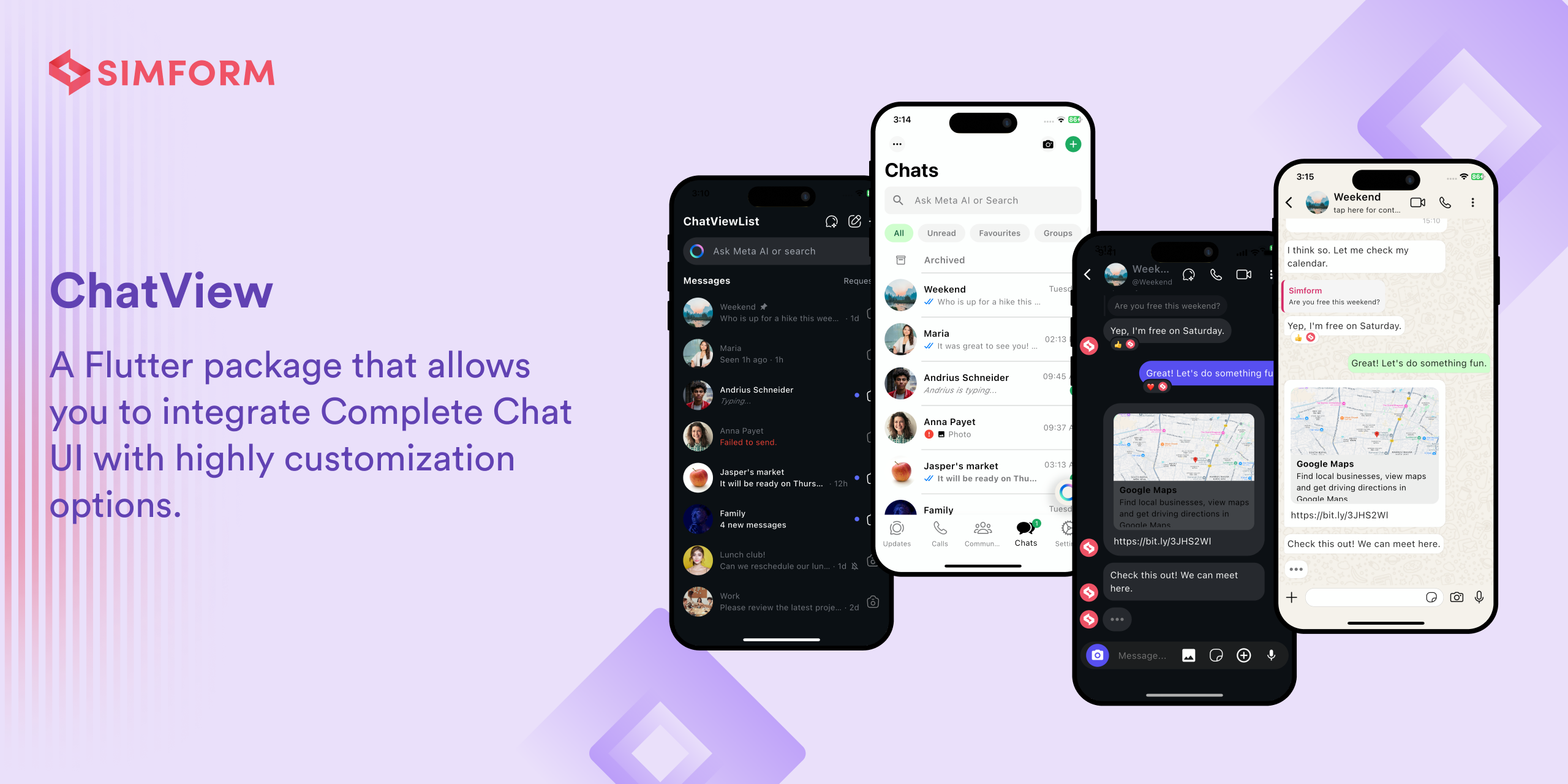



ChatView is a Flutter package that allows you to integrate a highly customizable chat UI in your Flutter applications with Flexible Backend Integration.
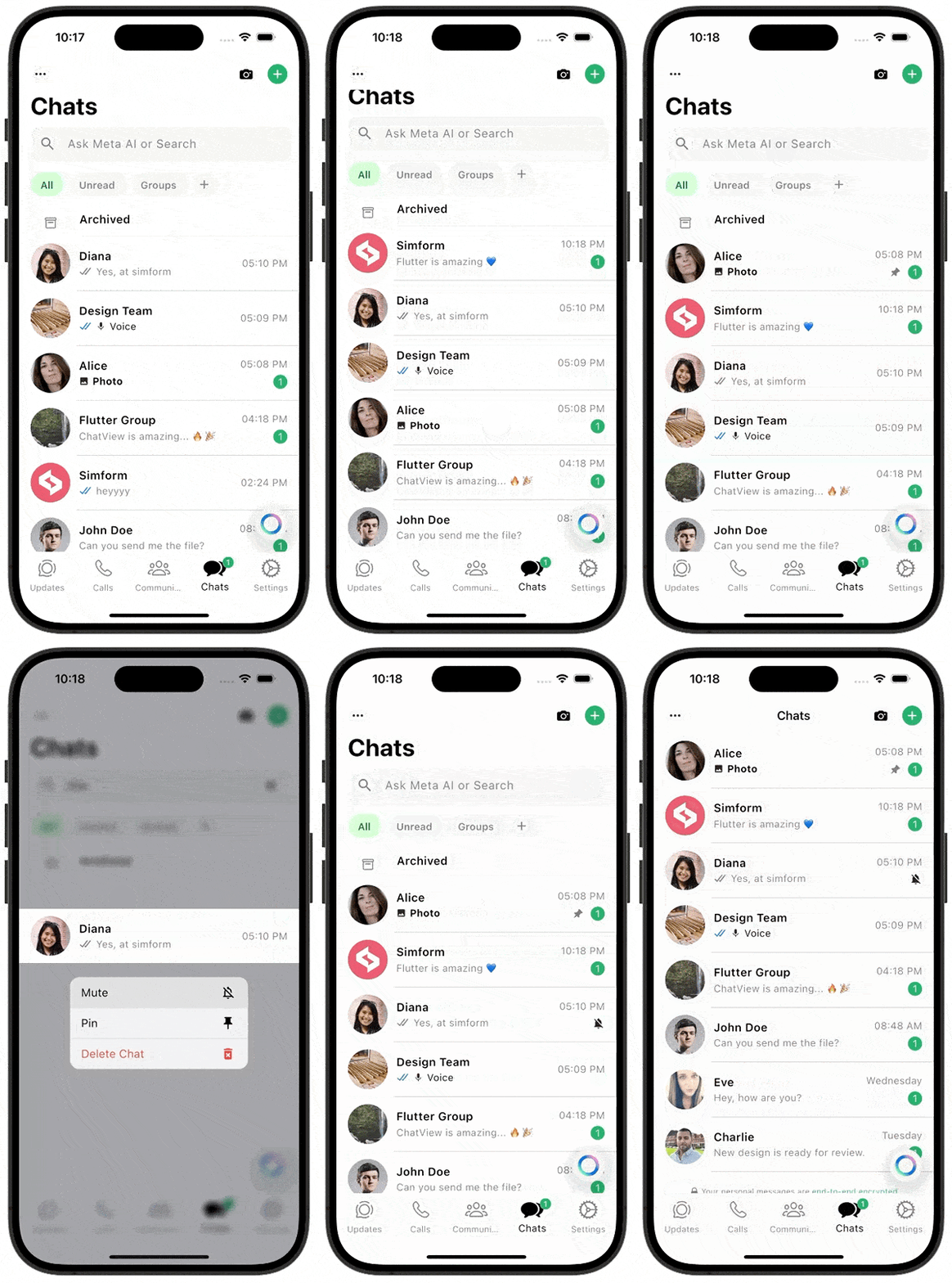
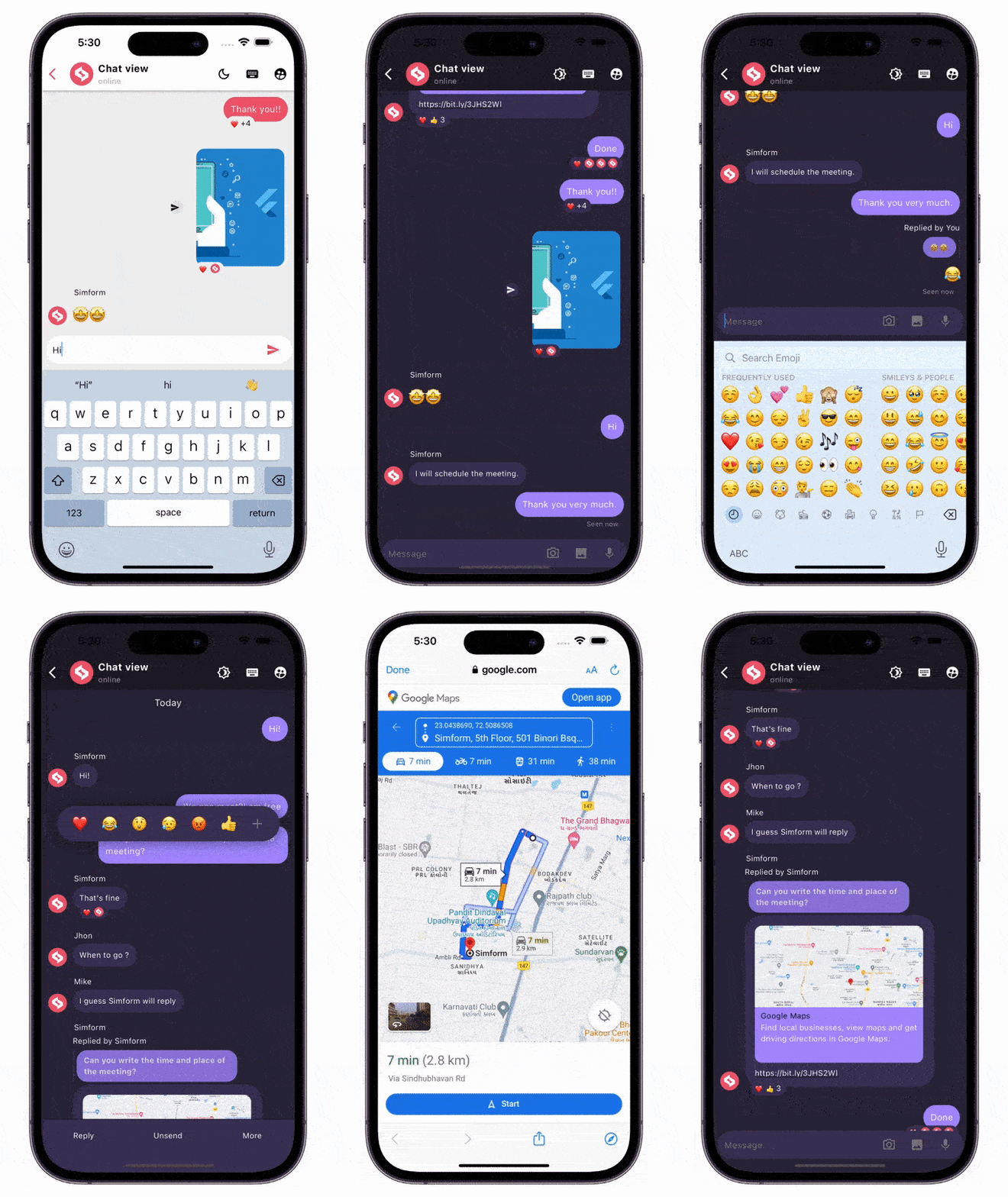
| ChatList | ChatView |
|---|---|
 |
 |
- Smooth animations for adding, removing, and pinning chats
- Pagination support for large chat histories
- Search functionality by name or other criteria
- Long press menu with options like pin and mute
- User online status indicators
- Typing indicators for active users
- Unread message count badges
- Header and Footer support for additional widgets
- Highly customizable UI components
- Plug-and-play backend support using chatview_connect
- One-on-one and group chat support
- Message reactions with emoji
- Reply to messages functionality
- Link preview for URLs
- Voice messages support
- Image sharing capabilities
- Custom message types
- Typing indicators
- Reply suggestions
- Edit Message
- Message status indicators (sent, delivered, read)
- Highly customizable UI components
- Plug-and-play backend support using chatview_connect
For a live web demo, visit Chat View Example.
Visit our documentation site for all implementation details, usage instructions, code examples, and advanced features.
dependencies:
  chatview: <latest-version>
Compatibility with chatview_connect
chatview version |
chatview_connect version |
|---|---|
>=2.4.1 <3.0.0 |
0.0.1 |
>= 3.0.0 |
3.0.0 |
Make ChatView backend-ready with chatview_connect
- 🔌 Easy backend integration without boilerplate (🔥 Firebase)
- ⚙️ Setup in 3 steps: set Service Type -> User ID and get
ChatManager - 💬 Supports 1-on-1 and group chats with media uploads (audio not supported).
For questions, issues, or feature requests, create an issue on GitHub or reach out via the GitHub Discussions tab. We're happy to help and encourage community contributions. To contribute documentation updates specifically, please make changes to the doc/documentation.md file and submit a pull request.
This project is licensed under the MIT License - see the LICENSE.