

AI Revenue Recovery Agent · Razorpay Buildathon, Track 03


Named for the Roman god of doorways and transitions, who looks both ways at once and decides what passes through.
Revenue leaks out of a business through disconnected failure points — failed card/UPI debits, failed subscription mandates, overdue B2B invoices — each usually handled reactively, generically, and with no record of what was tried or why. Janus is a single agent that detects revenue at risk across all three leak types, diagnoses the root cause per case, chooses a bounded recovery action across an escalating channel ladder (nudge → SMS/email → voice → human), executes it, and reports measured recovery (₹ at risk vs ₹ recovered) with a full audit trail and compliance/stopping rules the LLM cannot override.
This is not a live Razorpay integration — the batch runner works against a
synthetic environment with a hidden recoverability model, so the demo
proves the reasoning + guardrail + measurement loop rather than real
payment processing. POST /webhooks/razorpay is the one place a real
Razorpay event would land.
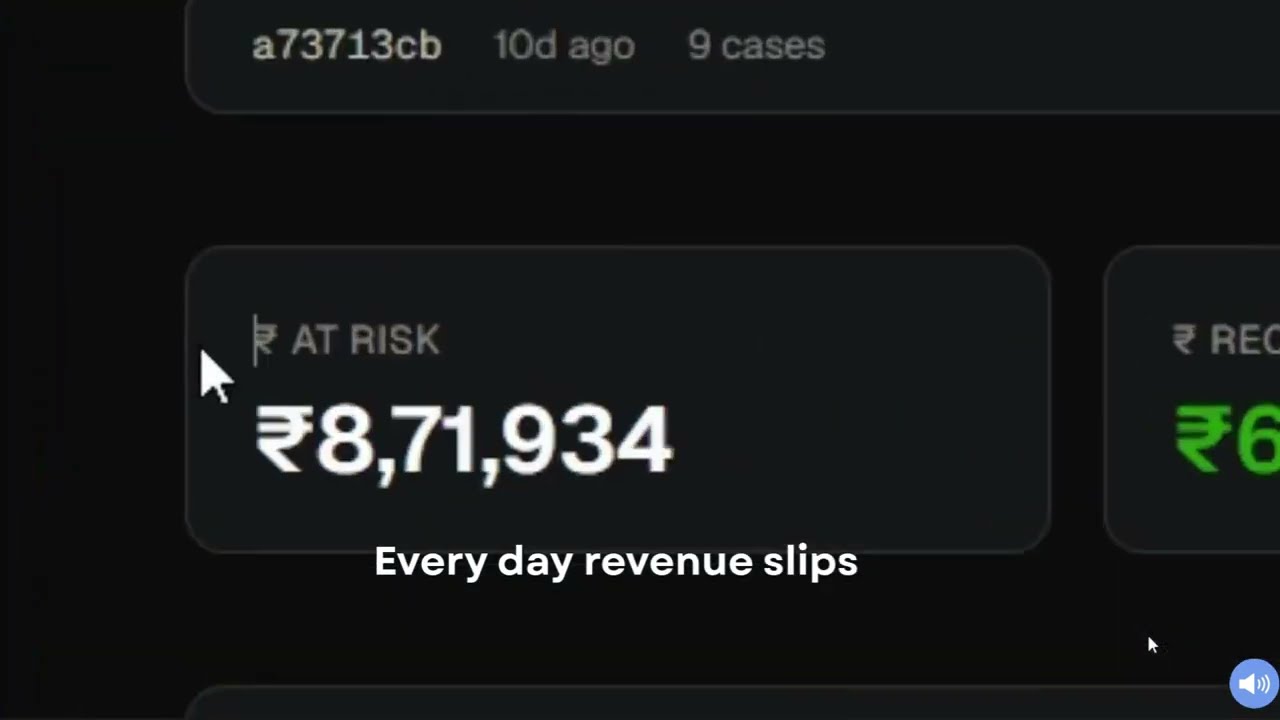
▶ 1:29 — click to watch on YouTube
- Features
- Architecture
- Quick start
- Tech stack
- Integrating Janus into a real stack
- Business value
- Engineering highlights
- Repo layout
- Three leak types, one agent — payment failures, mandate revocations, and overdue B2B receivables all flow through the same detect → diagnose → act → report loop instead of three disconnected tools.
- Root-cause diagnosis — deterministic rules classify unambiguous decline/failure codes; a Gemini fallback handles free-text or ambiguous cases only (kept to ~5% of volume by design, to control LLM cost).
- Bounded action policy — Gemini proposes the next recovery action per case (reminder tone, retry link, promise-to-pay ask, voice call, human escalation) from a fixed, allowed action set per case type.
- Guardrails that are code, not prompts — hard stopping rules (fraud/
dispute → instant human escalation, no LLM call at all) and compliance
substitution rules (e.g. a DND-flagged customer's
voice_callswapped for a compliant channel) run after the LLM proposes, and can override or substitute it outright. Independently unit-tested. - Full audit trail — every proposal, guardrail decision, execution attempt, and outcome is logged as a replayable event, not a summary number you have to trust.
- Multi-tenant, no login wall — every query is scoped by
merchant_id, so a business (or a judge) can be onboarded without a signup flow, with an opt-in per-merchant API key for when auth is actually needed. - Live dashboard — ₹ at risk/recovered, recovery rate by root cause, a guardrail-intervention feed, a recovery curve, and a scheduled-actions panel for cases mid-journey.
- Auto-generated support tickets — every human escalation opens a ticket, prioritized from the escalation reason (fraud/dispute → urgent, exhausted channels → high).
flowchart LR
    subgraph Simulated environment
        Gen[Batch generator<br/>+ hidden recoverability model]
    end

    Gen --> Detect[Detection<br/>rules + Gemini fallback]
    Detect --> Policy[Policy engine<br/>Gemini proposal]
    Policy --> Guard{Guardrails<br/>stopping rules + compliance}
    Guard -->|substituted/blocked| Exec
    Guard -->|allowed| Exec[Execution<br/>channel connectors + provider adapter]
    Exec --> Audit[(Postgres<br/>Case / Attempt / AuditEvent)]
    Audit --> API[FastAPI]
    API --> Web[Next.js dashboard]

    Webhook[POST /webhooks/razorpay] -.real event, bypasses the roll.-> Audit
Guardrails are plain deterministic Python with their own unit tests, not
prompt-only logic — they run after the LLM proposes an action and can
override or substitute it outright. See CLAUDE.md for the
full phase-by-phase build log, every route, and every design decision's
rationale.
cp backend/.env.example backend/.env   # then fill in GEMINI_API_KEY
GEMINI_API_KEY=your_key_here docker compose up --build| Service | URL |
|---|---|
| API | http://localhost:8000 (/health, /docs) |
| Dashboard | http://localhost:3000 |
One command boots Postgres, applies migrations, and serves both the API
and the Next.js dashboard — no local Python/Node install required. See
CLAUDE.md for the non-Docker local dev workflow (hot
reload, the pytest suite, individual CLI demo scripts).
| Layer | Choice |
|---|---|
| LLM | Gemini API (google-genai) — cost-driven substitute for Claude/Anthropic |
| Backend | FastAPI, SQLAlchemy, Alembic |
| Database | Postgres (Docker Compose) |
| Frontend | Next.js (App Router), TypeScript, Tailwind |
| Tests | pytest, transaction-per-test isolation |
Every seam a real integration needs already exists in this codebase, not just in the synthetic demo path:
- Ingest real failures via webhook.
POST /webhooks/razorpaymirrors Razorpay's actual scheme —X-Razorpay-Signatureis an HMAC-SHA256 of the raw body, keyed byRAZORPAY_WEBHOOK_SECRET.payment.capturedresolves the referenced case;payment.failedrecords an attempt. A different PSP just needs an equivalent adapter in front of the same case model. - Swap the channel provider, not the pipeline.
app/execution/ providers.py'sChannelProviderinterface is the seam where a real SMS/voice/email/WhatsApp API call happens. Implement it once against your real provider in place of the bundledLoggingChannelProvider, and detection, policy, guardrails, and audit logging are unchanged. - Turn on per-merchant auth when you need it.
REQUIRE_MERCHANT_API_KEY=truerequiresX-API-Keyon batch/job endpoints, checked against a key already generated per merchant — no separate auth system to build. - Pull data into tooling you already have.
GET /batches/{id}/summary,/guardrails,/curve, and/casesare plain scoped JSON — wire them into an existing BI dashboard, a Slack alert, or a support tool instead of the bundled frontend. - Pick your cadence. Call the pipeline synchronously per failure event
as it lands (
instant=True), or runPOST /jobs/run-dueon a real cron for realistic multi-day recovery journeys (instant=False) — the same code path either way.
Every case Janus works on is revenue that would otherwise sit as a manual-collections queue item or get written off outright — both pure cost centers today. The economics:
| Manual collections | Janus | |
|---|---|---|
| Marginal cost per case | Agent time (calls, follow-ups, CRM entry) | One bounded LLM call + channel cost (SMS/WhatsApp/voice), fractions of a cent to a few rupees |
| Coverage | Prioritized by case size, long tail often ignored | Every failure gets a decision, no case too small to work |
| Compliance risk | Depends on agent training/discipline | Enforced in code — calling-hours, DND, and contact-cap rules can't be skipped by a rushed agent or a misbehaving model |
| Auditability | Notes in a CRM, if any | Full event-level trail per case, reconstructible after the fact |
Because the alternative to recovery is usually ₹0, recovered revenue here is close to pure margin, net only of the (small) automation cost — and the guardrail layer converts compliance risk (an off-hours call, a contact attempt on a fraud case) from a training problem into a solved one.
Honest caveat: the recovery-rate numbers this repo's demo batches produce come from a synthetic recoverability model built to exercise the reasoning + guardrail loop for the buildathon, not a live guarantee — a real deployment's recovery rate depends on the merchant's actual customer base and would need to be measured against it directly.
- Gemini's free-tier rate limits were the biggest reliability risk. A
client-side token-bucket limiter, exponential backoff honoring
Retry-After, and a classification cache (app/llm_resilience.py) keep batches from collapsing mid-run; anything that still exhausts retries fails safe toescalate_humaninstead of crashing. - A sim-clock leak silently discarded LLM-chosen retry offsets, because retry dates were built from the wall clock while the runner advances a simulated clock days ahead. Fixed by threading the simulated clock all the way through to the proposal call.
AuditEventtimestamp collisions from Python-sidedatetime.utcnow()broke chronological ordering in the case timeline when multiple events landed in the same DB flush. Switched to Postgres'sclock_timestamp(), evaluated per row.- Zero-isolation tests were writing real rows into the dev Postgres instance, and one test file was silently relying on rows another file happened to commit first. Fixed with a transaction-per-test fixture (SAVEPOINT-based) that rolls back after every test.
Full incident-level detail — plus every phase's design rationale — is in
CLAUDE.md.
/backend      FastAPI + SQLAlchemy + Postgres; simulation, detection, policy,
              execution, audit layers; Alembic migrations; pytest suite
/frontend     Next.js (App Router, TypeScript, Tailwind) dashboard
/revenue-recovery-agent-prd.md   Full product spec
/CLAUDE.md    Build log: every phase, route, and design decision
Built by DewashishCodes for the Razorpay Buildathon (Track 03)