Repository navigation
Ruby SDK methods and error classes generated from the op registry - #1127
Conversation


scripts/codegen/sdk_rb_gen.py writes sdk/ruby/lib/clickhouse/loom/generated/:
ops.rb holds OPS (one OpSpec per served op: idempotency, read-only, role,
maturity, field names) and one class per op group with one method per op,
named as the Python SDK names them; errors.rb holds one Error subclass per
server code, from the same sources as docs/reference/errors.md. --check
runs in make lint, and tests/unit/test_sdk_rb_generated.py fails on drift.

Signed-off-by: rahulsjha <132360698+rahulsjha@users.noreply.github.com>
client.<group>.<method>(**fields) calls every served op with the bound org,
namespace and agent, a keyword of the same name overriding one per call,
and an unknown field refused before sending. Loom.configure and
LOOM_BASE_URL / LOOM_API_KEY set the defaults. Calls follow the
TypeScript SDK's retry rules: one Idempotency-Key per deduplicated op,
repeated on every resend; 408/5xx resent for idempotent ops; Retry-After
(seconds or HTTP-date) honoured; a 429 waited out within
rate_limit_max_wait. A server code raises its own Error subclass
(Loom::PinnedConflict, Loom::RateLimited, ...). The existing
set/get/search/delete methods keep their typed answers.

Signed-off-by: rahulsjha <132360698+rahulsjha@users.noreply.github.com>

|
The latest updates on your projects. Learn more about Vercel for GitHub.
|


 zlareb1
left a comment
zlareb1
left a comment
There was a problem hiding this comment.
One retry-bound defect remains. The submitted Ruby suite passes (68 tests), and the generator and checkout checks pass (23 tests). No live-server run was performed.
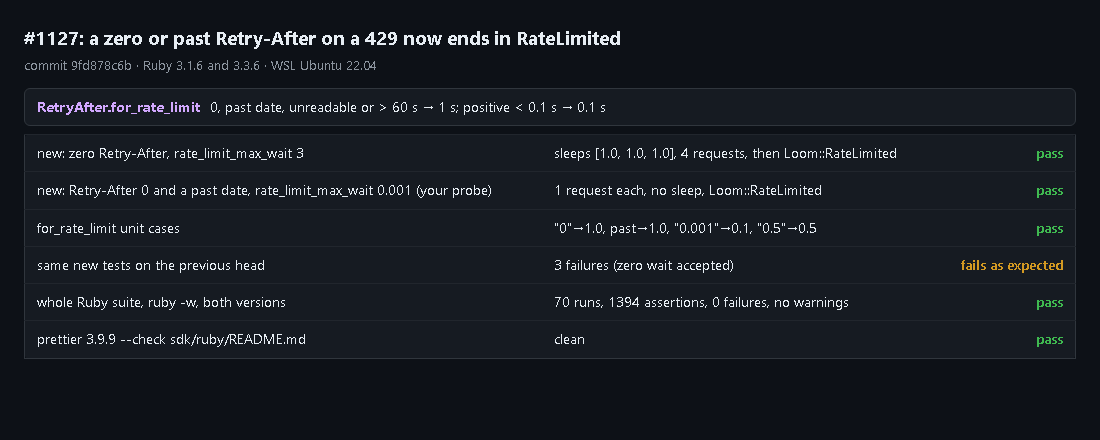
A 429 whose Retry-After is 0 or a past date gave a zero wait, so the rate_limit_max_wait check always passed and the call resent forever. Such a wait is now 1 s (as an absent one is) and any positive wait is at least 0.1 s, so every paced resend spends part of rate_limit_max_wait and the call ends in Loom::RateLimited.

Signed-off-by: rahulsjha <132360698+rahulsjha@users.noreply.github.com>

|
Thanks, you're right: a
|
zlareb1
left a comment
zlareb1
left a comment
There was a problem hiding this comment.
No findings. The zero-delay rate-limit loop is bounded, including a zero or past Retry-After and a wait budget below the minimum delay. On this head, all 70 Ruby tests pass with 1,394 assertions, and all 23 generator and checkout checks pass.
zlareb1
left a comment
zlareb1
left a comment
There was a problem hiding this comment.
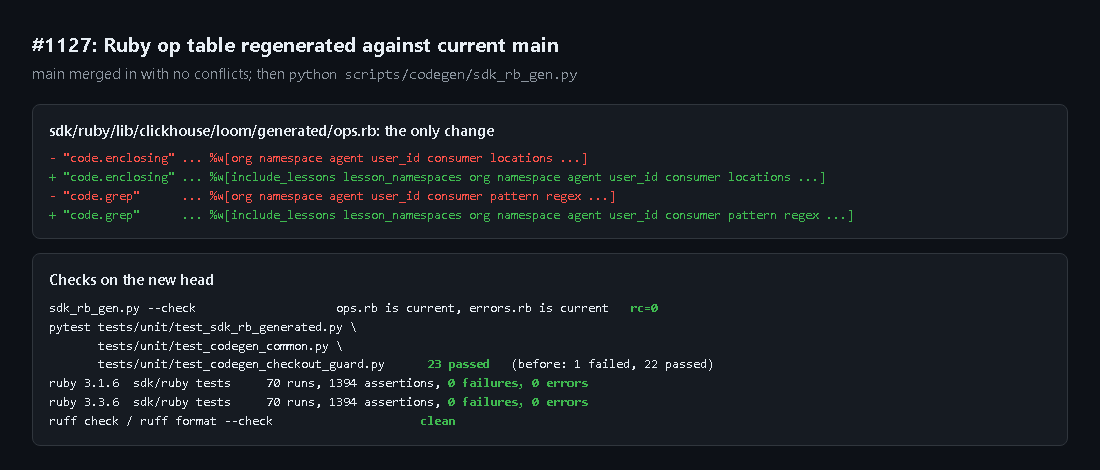
The retry fix passes on this head. Validation with the current base found a separate generated-table defect: test_sdk_rb_generated.py fails because the Ruby operation table no longer matches two served code operations. The other 22 generator and checkout checks pass.
…nclosing

Signed-off-by: rahulsjha <132360698+rahulsjha@users.noreply.github.com>
|
Thanks, fixed. I merged current main into the branch (no conflicts) and ran
|
zlareb1
left a comment
zlareb1
left a comment
There was a problem hiding this comment.
No findings. The generated operation table includes the lesson fields on code.grep and code.enclosing. On this head, all 70 Ruby tests pass with 1,394 assertions, and all 23 generator and checkout checks pass. Live-server tests were not run.


Part of #55.
This builds on the minimal Ruby client from #1027 (
sdk/ruby/). Every op the server serves is now a Ruby method generated from the op registry. The PR also addsLoom.configure, the retry and idempotency rules the TypeScript SDK follows, and one error class per server code. The existingClient#set/get/search/deletemethods and their tests stay as they were.What changed
scripts/codegen/sdk_rb_gen.py(new). It writes two files undersdk/ruby/lib/clickhouse/loom/generated/. It has--check, like the other SDK generators.ops.rb:OPSholds oneOpSpecper op (idempotent, read-only, role, maturity, the input's field names and the required ones). It also has one class per op group with one method per op, and the client's group accessors. 376 ops in 43 groups.errors.rb: oneErrorsubclass per server code, plusERROR_CLASSES(code → class). The codes come from the same functions that builddocs/reference/errors.mdindocs_reference.py, so the classes match the errors reference: 193 codes.make lintrunssdk_rb_gen.py --check.tests/unit/test_sdk_rb_generated.pyfails when a generated file is stale, astest_sdk_ts_generated.pydoes for TypeScript, so the unit suite catches drift.code-generation.md,adding-an-operation.md,CONTRIBUTING.mdand.claude/rules/wire-ops.mdname the new generator next to the TS and Python ones.operations.rb:OpSpec, andOpGroup, the base class of the generated groups.configuration.rb:Loom.configure.retry_policy.rb:RetryPolicyandRetryAfter.client.rb: identity binding, the generated group accessors, the genericcall, and the retry loop.errors.rb: maps each code to its class, and keepsdetail.Loomis set as a short name forClickHouse::Loom(Loom.configure,Loom::PinnedConflict, as the issue writes them). It is skipped when the app already defines aLoom.How generation works
client.<group>.<method>(**fields)posts/v1/<group>.<rest>. The method name follows the Python SDK:tracker.source.addisclient.tracker.source_add._. The only case today ismemory.inspect→memory.inspect_; without it, printing a group in irb would make an HTTP call. The generator refuses to write if two ops map to the same method, if a group name would hide a client method, or if an error class name would take a constant the gem defines by hand.org/namespace/agent, so a keyword of the same name overrides one for a single call.ArgumentErrorbefore sending, with the nearest field name:memory.set has no field valeu (did you mean value?).nilkeyword is left out. A Hash passed first is sent as it is, so it can carry an explicitnull.request_options: { idempotency_key:, retry_policy: }, a single reserved keyword. A plainidempotency_key:keyword would not work:task.createhas a body field namedidempotency_key, and some ops have fields namedbody,optionsandmax_attempts. The generator fails if an op ever adds a field namedrequest_options.client.call("some.op", {...})calls an op this gem version does not know yet.client.searchwith no argument is thesearch.*group. With a query it is still the existing typedsearch(query, ...).Retries, matching the TypeScript SDK (gaps listed under What's left)
Idempotency-Key, unless the caller passes one. Every resend in the call repeats it, along withX-Request-Id.X-Loom-Retry-Countcounts the resends.AUTH_UNAVAILABLE. Not resent: an error the server classesconfiguration, and the codes in the TypeScriptNEVER_RETRIEDlist.retryable, is marked not retryable, asmarkMaybeApplieddoes in TypeScript.retry_timeoutstakes:never,:idempotent(the default) or:always.detail.retry_after_s, replaces the backoff when it is at most 60 s.Loom.configure,Client.new(retry_policy:)or per call, and each is checked by name.Retry-After(1 s when it is missing or longer than 60 s) for up torate_limit_max_wait(15 s), then raisesLoom::RateLimited.X-Request-Idkeeps the ID the call sent, as TypeScript does. The server does not echo it on a 422, for example.One change to the #1027 client: calls are now retried by default, where before the client sent each request once. The README's "never retries" sentence is replaced. The existing error tests now build their client with
retry_policy: { max_attempts: 1 }, rate_limit_max_wait: 0intest_helper.rb, so each still reads the first answer it got. Their assertions are unchanged. A network error staysretryable? == false, as before. TypeScript marks a failed connect as retryable; I kept the Ruby client's existing flag.Tests
The tests run in WSL Ubuntu 22.04, on Ruby 3.1.6 and 3.3.6, with
ruby -wand no warnings. No server is needed.rake test: 68 runs, 1382 assertions, 0 failures. That is 11 existingClientTest, 20ErrorsTest(15 existing + 5 new), 13GeneratedTest, 18RetryTestand 6ConfigurationTest.request_options, multi-segment and shadowing names, and an unknown op. Every op inOPShas its method, the client reaches every group, and no generated name shadows anObjectmethod.Retry-Afterfrom the header and from the body, a too-longRetry-Afterfalling back to the backoff, and the sameIdempotency-KeyandX-Request-Idon every resend. Also: attempts running out, non-idempotent ops,AUTH_UNAVAILABLE, configuration and never-retried codes, 429 pacing and its budget, a refused connection, a timeout resent only for a deduplicated op, a per-call policy, policy validation, and HTTP-date parsing.PinnedConflictwith itsdetail,RateLimited, an unknown code raisingError, and every generated class naming its code.FakeServercan now delay an answer and serves each connection on its own thread, which the timeout test needs.pytest tests/unit/test_sdk_rb_generated.py: 7 passed. These check that both generated files are current, that--checkreports a stale file, that every registry op appears inops.rb, the method naming, that no error class hides a constant the gem uses, and that the error classes equal the codes inerrors.md.test_codegen_common.pyandtest_codegen_checkout_guard.pystill pass.python scripts/codegen/sdk_rb_gen.py --check: both files current.ruff checkandruff format --check(0.16.9) are clean,scripts/gates/check_no_secrets.pyfinds nothing, and prettier (3.9.9) leaves the touched Markdown unchanged.gem build clickhouse-loom.gemspecpackages the generated files.Live check
I ran this checkout's server (
uvicorn server.main:app, auth off,fake-ngram-1024embedder, native ClickHouse, migrations applied) and then a short script that uses only the generated methods:memory.setreturnedactive. Sent again with the sameIdempotency-Key, it returned the same version, which is the server's replay.memory.getreturned the value and tags.memory.searchranked the memory first. With a per-callagent:override it returned 0 hits.client.get(key)still returns its typedMemory.memory.setover a pinned key raisedLoom::PinnedConflict(PINNED_CONFLICT, 409, request ID kept).ArgumentErrorbefore sending, and a bad input raisedLoom::ValidationFailed(422).memory.deletetombstoned the key, and a latergetreturnedfound=false.agents.connectedandblacklist.list, whose inputs have noagentfield, accept the boundagentthe client sends with every call, as the Python SDK sends it.What's left
sdk/rustjob inci.yml(around line 1280) is the pattern:ruby/setup-rubywith 3.1 and 3.3, thenbundle exec rake testinsdk/ruby. Thelintjob's "generated loom/ops.py and loom/client.py are current" step could also runsdk_rb_gen.py --check. For now, the drift check runs throughmake lintand the unit suite. I left workflow files alone so a maintainer can choose the job layout.X-RateLimit-*headers before a 429 arrives, a per-call timeout option, and resending a 401 once with a fresh token (the gem takes a fixedapi_key).Loom.configureinitializer and the per-callnamespace:override. I can add it here or in a follow-up.An AI agent helped with this; I reviewed the change and ran the tests and the live check myself.