Last updated with AmiWind v0.0.46 (21 October 2026). FAQ revision 22.
- What is possible on the Amiga?
- Why Morrowind?
- Why build something so demanding before optimizing it?
- How do non-destructive conversion, fallback paths and versioning fit in?
- Why AGA graphics?
- Does real AGA hardware have enough graphics bandwidth for this?
- What hardware is the current version targeting?
- Can today's heavily upgraded Amigas realistically run AmiWind?
- Can AmiWind use more RAM if my Amiga has it?
- Why can AmiWind in FS-UAE run better than native OpenMW on a small PC?
- Does running in WinUAE or FS-UAE prove real-hardware performance?
- Why not use PiStorm32, RTG and MiniGL?
- Can a MiSTer run AmiWind?
- Can a Vampire (Apollo 68080) run AmiWind?
- Is this a Ship of Theseus question about what counts as an Amiga?
- Why start from AmiQuake?
- Why not just run OpenMW under Linux on a PowerPC Amiga?
- What does the optimization pipeline actually work on?
- Is this complete Morrowind, here and now?
- How much of Morrowind is currently working?
- Which tools help inspect the converted world?
- What can future Amiga and m68k developers get out of this?
- Do I need my own Morrowind files? What is included in the release?
- What would help establish what lower-spec Amigas can do?
Harry Horsperg's perspective as the project's author.
Latest release: v0.0.45 - CHIM Streaming Improved, Guard Torches Are Back. Crossing from one CHIM cell to the next reads the frames around the player ahead into spare Fast RAM, and the engine's heap grows with the RAM the machine has; the guards in the streets carry their torches at night again (release notes). Since v0.0.43 every exterior cell of Vvardenfell is on the CHIM engine: 1,409 cells, 1,348 in one-cell region frames and 61 in the town frames of Balmora, Seyda Neen and Vivec (what these numbers count). Next: crossings without a level restart (the frame switched in place), then every interior of the base game that is still missing, as listed in the plan. See the progress tracker, the roadmap and the bug tracker.
That is the question driving AmiWind.
When the Amiga 500 came out, the Amiga already represented the future to me: a beautiful multimedia machine that felt unique in its time. That feeling continued with the A1200 and beyond. It is still part of why I want to create for the Amiga.
Morrowind on the Amiga has always been a dream of mine. I love Morrowind, and I love the Amiga. I wanted to make that dream a reality for all Commodore Amiga and TES III: Morrowind fans, and to see what we can optimize and make possible. Bringing the two together is the point of this project.
It needs to be Morrowind, and it needs to be on the Amiga at the same time. The world, atmosphere and identity need to survive the journey, while the way we represent and run them has to work within the Amiga's constraints.
AmiWind is an open-source RPG engine and a conversion pipeline. It is also an optimization project in progress: the playable game gives us a demanding world to work with, measure and improve. Finding out how far we can take it is a central part of the project.
The code is free and open source under the GPL, with the applicable versions explained below. I want this work to open doors for future Amiga game developers and inspire more development across the Motorola m68k family.
Dreams can become working software. Then comes the work of making that software fit, run better and reach less powerful machines.
Because Morrowind is, and has always been, an otherworldly game title.
Morrowind ♥ Amiga ♥
Harry Horsperg (FlyingFathead) gives his perspective here as the AmiWind project's author.
Morrowind turns 25 on 1 May 2027: it was first released in North America on 1 May 2002. AmiWind is a 25th-anniversary celebration of one of the greatest RPGs ever made. It is the game that inspired me to start tweaking the AmiQuake engine, to see how much of Vvardenfell a Commodore Amiga can hold. The aim, not a promise, is the whole island running on the Amiga in time for the anniversary.
During this process, I have found out so many cool things about the Commodore Amiga that I wanted to share with anyone who's interested in these retro platforms. My dream is to one day make this framework a "create your own adventure" style base engine for every old school Amiga enthusiast out there.
My approach is to "overdo" first, then optimize, optimize, optimize.
First, get all the assets in. Then optimize the compiler/conversion pipeline and the runtime. That is the overall development order.
We need the intended content in place so that we can map out what is there, how it is represented and what it costs. Then we can use that complete content baseline to work systematically on reducing the requirements. Individual repairs and improvements already happen along the way; the larger optimization phase follows the asset integration work.
Lower-spec Amigas are part of the plan. Once we have mapped out the content and its costs, we will work on ways to bring that experience to less powerful configurations. The current demanding development build gives us something concrete to investigate and improve.
That means measuring several different things: geometry, memory, loading time, rendering time, display conversion and storage. A slow scene is a problem to understand and solve. Its current speed does not define the project's eventual hardware requirements.
The intended progression is:
- Get all the assets into the conversion pipeline and build the intended content baseline.
- Measure where the work, memory and data go.
- Change the representation or implementation to reduce those costs.
- Check the result, including appearance and gameplay, and repeat on more constrained configurations.
The specific minimum machines and acceptable performance will be established as those configurations are developed and tested. See the assemble-first optimization roadmap.
My aim is to keep this non-destructive. Preserve the original inputs and earlier working representations, then produce new versions that we can compare, select or fall back from. Trying a cheaper representation should leave us able to return to the source and try a different approach.
We already have several alternative representations and fallback paths:
- Scenery uses both converted meshes and sprites, including different foliage representations in different areas.
- The first-person hands have a retained 3D path and an experimental sprite build option for a limited Nord unarmed prototype. A broader race/equipment catalogue captured with transparency from OpenMW is a new investigation, not a completed replacement. See hand-rendering scope.
- Sky resources have versioned formats and conversion revisions. The documented upgrade path backs up older night-sky data before replacing it, or retains it with a legacy warning when the necessary source textures are unavailable.
The project overview, runtime options and sky resource documentation describe these existing examples. Retained variants and versioned checkpoints give the optimization work a baseline to return to; the broader range of target-specific choices will grow as more content is integrated and measured.
If a lower-spec version ultimately needs a more Daggerfall-like presentation, so be it. More sprites or simpler geometry may be part of finding a workable balance while preserving Morrowind's world, atmosphere and gameplay.
First, let us bring Morrowind across to the Amiga. Then we can make those decisions against the actual content and its measured costs, with the original inputs and other representations still available.
Because I love AGA graphics. They are a big part of the Amiga feel I want AmiWind to have.
There is both a personal and a technical reason for keeping that target. AGA gives the project a native Amiga display path with concrete constraints to work against. Exploring what can be achieved within those constraints is part of the attraction.
The chosen display, colours and performance tradeoffs are part of how Morrowind becomes an Amiga experience. Retaining that character matters alongside making the software faster. Additional display options can have value too; AGA is central to the version I want to develop.
AGA bandwidth is a real constraint. So are CPU speed, available memory, visibility processing, texture access and loading costs. Their importance depends on the actual scene, renderer and machine.
AmiWind's current native display defaults to 320 × 200 with 8-bit indexed colour. The CPU renders the 3D view in software. The native display path then performs chunky-to-planar conversion, arranging the pixels into the bitplanes that the Amiga chipset displays. See the video backend and conversion routine.
At that resolution and depth, one complete image contains 64,000 bytes of pixel data, or 62.5 KiB. More objects can make the scene much more expensive to render, but they do not increase the size of that finished image. The world and the renderer determine how much work is needed to produce it.
That arithmetic alone cannot establish a frame rate. Drawing and converting the image, writing its bitplanes, display DMA and competing memory accesses all have costs. Display data lives in Chip RAM, which the CPU shares with the custom chips; other engine data can use Fast RAM. The AmigaOS documentation explains this memory distinction.
The practical answer will come from measuring particular real configurations and optimizing their bottlenecks. The original PC game's complexity by itself does not establish whether a converted scene is feasible. This is exactly the question AmiWind's pipeline is meant to investigate.
The published development reference is an accelerated AGA emulator configuration:
| Part | Current reference |
|---|---|
| Machine and chipset | A1200 / AGA / PAL |
| CPU and FPU | Emulated 68040 with FPU |
| Chip RAM | 2 MiB |
| Additional RAM | 128 MiB Zorro III memory in the playtest emulator setup (since 21 October 2026); 16 MiB is the smallest the game runs on |
| CPU execution | JIT enabled, maximum emulated CPU speed |
| Default game display | 320 × 200, 8-bit indexed colour |
These settings are recorded in the FS-UAE preset, WinUAE preset and AGA build guide. The Zorro III setting describes the emulator's memory configuration; it is not a specification for an ordinary A1200 expansion.
The standard engine build currently targets a 68040 and FPU (the game disk also carries a 68060 engine, started automatically on a 68060), and the supplied startup checker requires AGA and sufficient memory. A stock A1200 or stock A500 is therefore not a supported configuration for this build. The earlier A500 experiment remains in the repository, alongside the current accelerated AGA track. See the engine build settings, startup checker and project overview.
Bringing the experience down to lower specifications is planned work. A particular physical accelerator, memory configuration or minimum frame rate still needs its own measurements and validation.
Yes, on paper: their specifications and CPU/FPU support make them a credible path, especially an A1200 with a PiStorm32 Lite and a Pi 4 or CM4. This assessment comes from the hardware documentation and the source code. A real AmiWind run on such a machine is still needed to confirm compatibility and frame rates.
These are concrete configurations that retain Commodore AGA, checked against project and builder documentation reviewed on 6 October 2026:
| Configuration | CPU and memory available | Why it is a credible candidate |
|---|---|---|
| A1200 + PiStorm32 Lite + Pi 4 or CM4 | Emu68 JIT with FPU support; the hardware project recommends a CM4 Lite with 2 GB RAM. Firmware and JIT reservations use part of that memory. | Supplies the CPU/FPU capabilities and substantially more memory capacity than the current development reference, while retaining AGA. |
| A1200 + TF1260 with a full 68060 | 128 MB Fast RAM; starts at 50 MHz, with firmware settings up to 100 MHz subject to the fitted CPU and stability. | A physical FPU-equipped 68060 and ample Fast RAM on a Commodore A1200. |
| A4000/A4000T + BFG9060 with full MC68060RC50 Rev. 6 | 128 MB Fast RAM; the builder documentation lists a 50 MHz default and optional 100 MHz operation for suitable Rev. 6 CPUs. | Another actual Commodore AGA platform with a full 68060/FPU and substantial memory. |
Sources: PiStorm32 Lite hardware, TF1260 builder documentation, BFG9060 builder documentation. Higher 68060 clocks depend on the CPU and cooling. LC/EC versions lack the full CPU's FPU; the physical 68060 configurations also require the appropriate 68060 system-support libraries.
The PiStorm case has specific source support. Emu68 identifies as a 68040 and includes an automatically initialized support library. Its library initialization code sets the 68040 and FPU flags that AmiWind's startup checker expects when the FPU is present. Its configuration documentation also documents the FPU. The hardware FAQ currently identifies Pi 4/CM4 support; Pi 5/CM5 should not be assumed compatible.
The PiStorm project's published benchmarks include CoreMark results and DoomAttack through AGA. These provide context from other software and documented configurations. CoreMark is an integer workload; the DoomAttack test specifies NTSC low resolution. Neither is an AmiWind measurement or a direct prediction of its frame rate, Chip RAM bandwidth or loading performance.
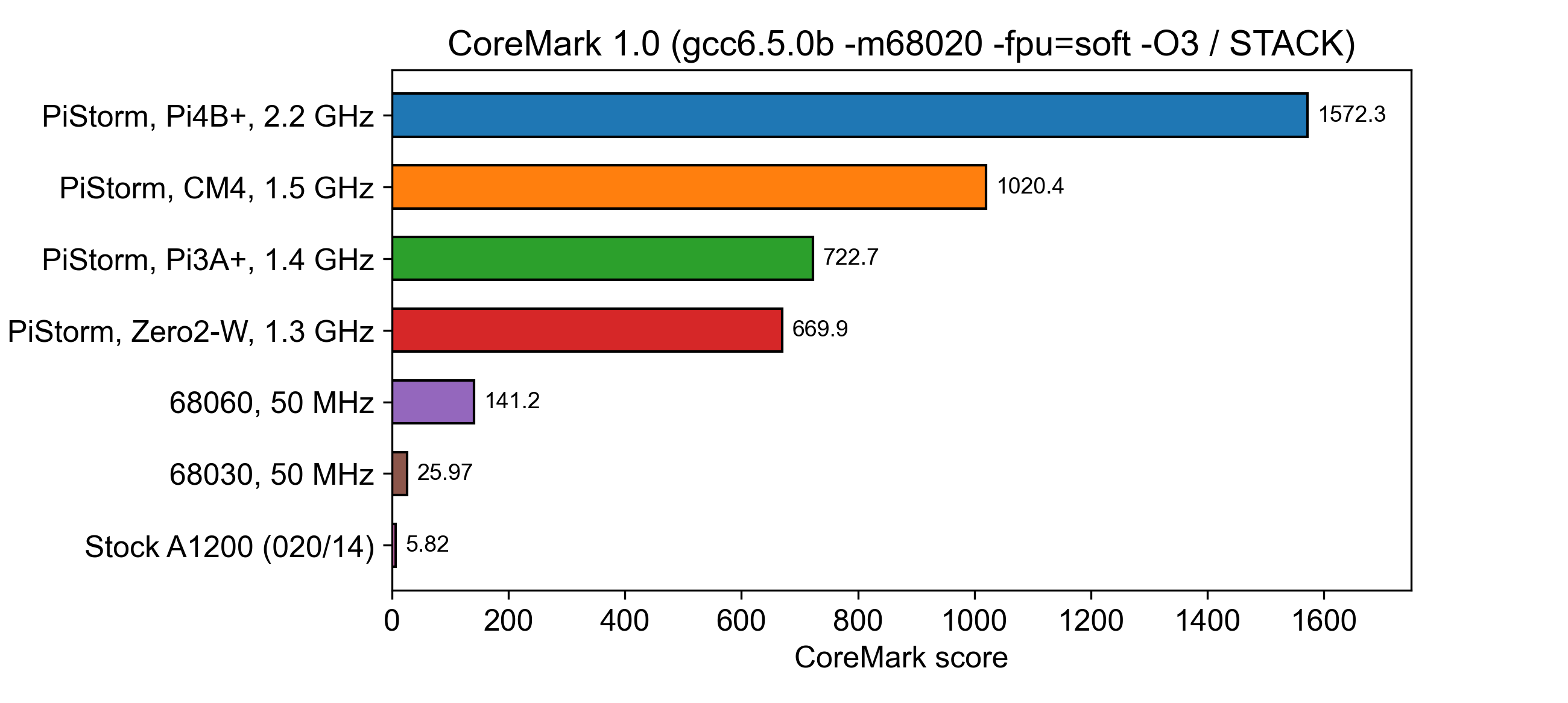
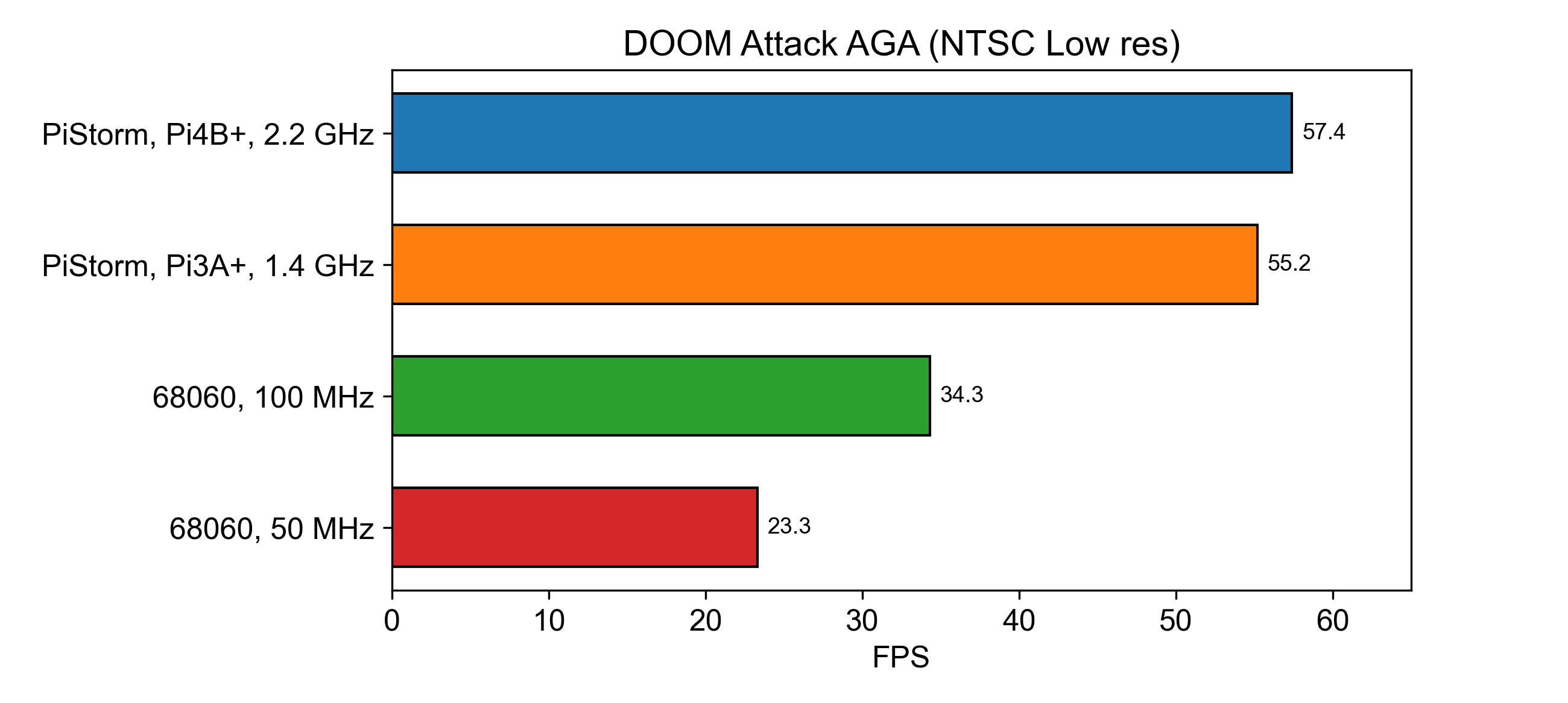
There is therefore a sound reason to pursue these machines. Extra installed RAM does not enlarge AmiWind's 11 MiB game heap, defined in the runtime allocation code; it goes to the CHIM engine's cache instead (next answer). Earlier measurements on the classic world showed where more would help: a fully loaded Seyda Neen sub-cell leaves only about 2.6 MB of the heap for cached models, so each crossing evicts and re-reads actor models (see Seyda Neen performance). A larger heap on a high-memory machine could keep them across crossings; this is untested. CPU rendering, AGA presentation, loading and audio still need to be measured together on the selected configuration.
Yes, for the CHIM engine's cache, and you can turn it off. At start the engine
looks at the Fast RAM that is free beyond a safety margin and uses it as CHIM's cache:
shared models, textures and world chunks stay in memory across map changes instead of
being read from disk again. The startup logo says how much it found; pressing M there
starts that session on the standard memory, and Options > Extra RAM: Off keeps it off.
See real hardware for the settings (-chimcache, aw_autoram,
-heapmb).
The baseline stays the contract: 2 MiB Chip RAM and 16 MiB Fast RAM is the machine AmiWind has to work on, and every route is tested there first. Extra memory means fewer loading pauses, not heavier frames: the view distance, detail and number of active characters stay the same.
The game heap itself (Quake's own cache for actors and sounds) is still a fixed
11 MiB from the build unless the start argument -heapmb N says otherwise; sizing it
from the free Fast RAM is planned
(ENGINE-HEAP-FIXED-SIZE-43).
Two limits stay whatever the RAM: Chip RAM (the display and sound hardware can only use Chip RAM), and the map format's own limits. Classic expansions reached 128-256 MB and a PiStorm setup has far more; on such machines much or even all of the world could stay in memory. How much each setup gains will be measured, not assumed.
On my smallest Linux NUC, I have observed AmiWind running better through FS-UAE than OpenMW running natively. That is a useful observation about those runs, even though it is not a controlled benchmark.
A converted game can require sufficiently less work that it remains faster after the cost of emulation is added. AmiWind uses a reduced representation and a low-resolution software renderer, and currently implements a smaller set of game systems. OpenMW runs a different engine and workload. Resolution, view distance, effects and scene settings can change the comparison further.
The observation supports investigating what the conversion and optimization approach can achieve. It does not provide a direct conversion from NUC speed to PiStorm or a physical 68060: their CPU execution, chipset access and I/O costs differ. The way to find that relationship is to run the same AmiWind scene on the actual target. See the runtime scope and emulator configuration.
It demonstrates the native Amiga program running under the stated emulated configuration. It also lets us inspect behaviour, reproduce problems and test changes throughout development.
The current presets use JIT and maximum CPU speed. Selecting an emulated 68040 does not make the resulting frame rate a measurement of a physical 68040 at a particular clock speed. FS-UAE's own CPU-speed documentation distinguishes these execution modes.
Physical-hardware performance remains to be established. Useful results need to identify the build, CPU or accelerator, memory, storage, display mode and scene being measured. Emulator demonstrations are useful development evidence; real-machine tests will establish what those machines can do.
Those are useful possibilities to explore. They address different parts of the problem:
| Technology | What it can change |
|---|---|
| PiStorm acceleration | The performance available for executing the Amiga program and its CPU workload. |
| RTG display | The framebuffer and display path. A suitable chunky display backend can avoid native AGA chunky-to-planar conversion. |
| MiniGL with a suitable 3D implementation | The rendering API and potentially the hardware doing the 3D drawing, for a renderer adapted to use it. |
RTG output and GPU-accelerated 3D rendering are separate capabilities. A software renderer can use an RTG display while still drawing its polygons on the CPU. Using MiniGL for that work requires an appropriate renderer integration; installing a library alone does not change the existing rendering code. See the PiStorm RTG guide and the PiStorm3D developer discussion.
AmiWind's inherited video source already contains CyberGraphX/RTG paths. Their presence does not establish a validated PiStorm/RTG release. The documented configuration and supplied startup checks still target AGA, and the current renderer uses software drawing.
Picasso96 and CyberGraphX, the two common graphics card systems on the Amiga, are nearly compatible: Picasso96 also provides the CyberGraphX programming interface, so one RTG display path can serve both. The renderer already draws each frame into an 8-bit chunky buffer (one byte per pixel). An 8-bit chunky RTG screen can take that buffer as it is, without the chunky-to-planar conversion that AGA needs; the inherited video code has such a direct CyberGraphX path. The emulators' virtual graphics card (UAEgfx, in WinUAE and FS-UAE, with the Picasso96 software installed on the emulated Amiga) makes that path testable without a real card.
Today the screen is not what limits a frame: the 3D work is. On a slow accelerator most of a frame goes into drawing the scene, above all the placed models, before any picture reaches the screen (see where a slow frame goes). An RTG screen would save the conversion step, but the large gains have to come from the 3D work first.
More CPU power or another display backend can expand the available budget. Loading, memory use and gameplay systems still need their own work. AGA remains a deliberate part of the project's identity, out of the maintainer's love of the Amiga's own OCS and AGA graphics modes and their palettes. RTG is a possible future path to look into, beside AGA rather than instead of it, for the faster machines where the screen starts to matter (PiStorm, Vampire, graphics-card Amigas); see the roadmap. For how another PC role-playing game port fares on PiStorm, Vampire and 68060 hardware, see Comparisons.
Not at present. MiSTer rebuilds classic machines in an FPGA rather than emulating them in software, and its Amiga core, Minimig-AGA, has the AGA chipset AmiWind draws to. Its CPU is the limit: the core offers a 68000, 68010, 68EC020 or 68030, and its documentation states that there is no FPU (read 18 October 2026).
AmiWind's engine is built for a 68040 or 68060 with an FPU and uses floating-point instructions throughout, so it stops on a machine without one. A version without the FPU would mean rewriting the engine's arithmetic, and a 68030-class CPU would still be far below the frame budget of the hardware AmiWind targets. The core's large Fast RAM option and its RTG output would not change that: AmiWind uses extra Fast RAM as its world cache, but the CPU and FPU come first.
Machines with a 68040 or 68060 accelerator, or a PiStorm (which presents a 68040 with an FPU), are the ones to try. If a later version of the core gains a 68040-class CPU with an FPU, this answer changes.
Possibly, but nobody has tried it yet. The Vampire cards and the Vampire V4 standalone use the Apollo 68080, a 68k-compatible CPU in an FPGA that, unlike the MiSTer core, has an FPU. Its makers state that it outperforms a 68060.
What speaks for it:
- The FPU. AmiWind's engine uses ordinary single- and double-precision floating point, as Quake does. It does not rely on the 68882's 80-bit extended precision, the area where FPGA floating-point units have differed most from the original chips.
- The speed. A CPU in the 68060 class or above is what AmiWind targets.
- The SAGA chipset. It is compatible with AGA and adds chunky screen modes (one byte per pixel). AmiWind draws every frame into such a buffer, so a SAGA screen could skip the chunky-to-planar conversion that AGA needs. The engine's inherited RTG display path is a starting point for that, untested on SAGA.
What is unknown:
- The 68080 is its own design, not an exact 68040 or 68060. An FPU instruction it implements differently would only show up in a real run, and it may suit a build profile of its own, as the 68060 has.
- The A1200 card and the standalone V4 may behave differently on the AGA path.
A first report (which card or model, the core version, Fast RAM, the awbench results and whether the game
reaches the world) would answer this. See what to send back.
There is a Ship of Theseus question in heavily upgraded machines: how much can change while we still regard the result as the same thing? A faster CPU, different graphics hardware, replacement storage and a changed software stack can each move someone's personal boundary.
For me, retaining AGA is a meaningful part of preserving the Amiga feel. It is one of the things I want this particular project to keep as it develops. That is a creative preference, and people can reasonably draw their own lines elsewhere.
The same design question applies to the experience we are adapting: how much can its representation change while it still feels like Morrowind? Recognizable places, atmosphere and the intended gameplay matter. Preserving Morrowind's identity and the Amiga experience is the challenge.
AmiQuake was the best available starting point I found for this project: an existing, optimized Amiga 3D game engine with GPL-licensed source.
It gave the project a practical foundation for software rendering and Amiga integration, so development could concentrate on bringing over Morrowind's world and building the conversion pipeline and runtime changes it needs.
The Amiga runtime contains id Software's Quake, by way of the AmiQuake port, changed and extended for AmiWind. The conversion tools prepare the original game data on the PC, and the Amiga runtime reads the converted result. OpenMW serves as a reference for formats and behaviour; none of its engine is linked into the current Amiga program. See licensing, provenance and credits.
John Carmack ♥ And thanks to the other id Software and Quake contributors, and to Peter McGavin, NovaCoder and Stephen Leary for the Amiga engine work that helped make this starting point possible.
There have been ready-made OpenMW packages for 32-bit PowerPC, the kind of CPU on PowerPC accelerator
cards: Ubuntu 16.04 LTS shipped OpenMW 0.38.0 for its powerpc port
(the package files, checked 18 October
2026). That was the last such build: later Ubuntu releases dropped 32-bit PowerPC, Debian never shipped OpenMW
for it in a release, and the current build for its powerpc port is
waiting on missing dependencies. Newer
versions exist for 64-bit PowerPC (ppc64, ppc64el; Debian's OpenMW package),
which a 32-bit PowerPC card cannot run. So the route exists, with a version from 2016, and whether it is
usable on a particular machine still depends on running Linux on it and on its graphics support: OpenMW needs
OpenGL, which an AGA Amiga's chipset does not provide.
If you want to enjoy Morrowind through OpenMW on 68k hardware, as well as it runs there: Debian's m68k port has built OpenMW and it is available (Debian's OpenMW package, the m68k entry under the ports). It is outdated, though: the m68k build is OpenMW 0.47, while the latest OpenMW release is 0.51.0 and 0.52.0 has been in development since August 2026 (openmw.org). OpenMW also needs hardware OpenGL, which a classic 68k Amiga does not have.
Even where it works, that would not fulfil the purpose of AmiWind. I want this retro Amiga adaptation: Morrowind's identity, an Amiga runtime, AGA's character, and the work of finding what we can fit and optimize on these machines. Turning the project into an OpenMW variant would change that goal.
OpenMW remains a valuable reference for formats and behaviour. AmiWind's own conversion pipeline and Amiga runtime are how we are pursuing this particular dream. See project provenance.
There is work on both sides of the build.
The host tools convert and organize the source world, models, textures and media. They also provide ways to inspect generated geometry, compare compiled outputs, examine sharing and duplication, and estimate loading allocations. The Amiga runtime determines the cost of using that data: visibility, software rendering, lighting, loading, display conversion and gameplay.
The AmiWind Map Optimization Toolkit brings together the inspector, conversion work and validation tools. It is still evolving. Individual optimization passes have their own implementation and validation status. For example, the bounded hidden-surface detector has produced zero house-interior cuts in documented trials; broader automatic removal remains unfinished. See the measured findings and hidden-surface status.
The shared-sky work gives a concrete example of a completed reduction: 301,751 local sky faces were removed across 2,664 exterior maps. The documented comparison, counting the shared sky resource once, saved 131.324 MiB of disk storage. That is a result for that conversion pass; resident memory, loading time and frame time have their own measurements. See the build comparison and sky implementation notes.
Making data smaller only counts as a useful optimization when the necessary appearance and behaviour survive. Terrain joins, visible surfaces, texture mapping, collision, shared placements and game state all matter. Even cutting away a buried surface can create extra fragments, so the written result needs to be checked and measured. The goal is a cheaper representation of the experience we want to preserve.
No; not at the moment, but I am working on it.
Getting all the assets in, implementing all the gameplay, and optimizing the result are substantial parts of that work. The current scope is described below.
As of 19 October 2026, the latest release is v0.0.44: By Azura's Trees!, a patch release for v0.0.43: Let There Be CHIM: Vvardenfell's Outdoors, All of It. Since v0.0.43 every exterior cell of Vvardenfell runs on the CHIM engine (1,409 cells: 1,292 land cells, 98 sea-floor cells and 19 open-sea cells; what these numbers count), from Seyda Neen, Balmora and the whole city of Vivec to Ald-ruhn, Maar Gan, Suran and Red Mountain; no classic region maps are left outdoors. Interiors are still classic Quake maps, and many of the base game's interiors are not in the build yet: on 19 October 2026, 176 of Vvardenfell's 1,134 interior cells were converted and reachable (v0.0.45 plan). The CHIM Progress Tracker shows which cell is which. "Release" here identifies the project's release track; AmiWind as a whole is still an early work in progress.
The documented playable scope now includes:
- Base-game Vvardenfell terrain and growing scenery, with more detailed Seyda Neen and Balmora areas and converted interiors.
- The opening registration and character-creation sequence, including race, appearance, class, birthsign and final review.
- Movement, mouse look, collision, doors, bounded NPC greetings and a character model gallery.
- A journal, world map and save support for the implemented character and progression state.
- Day and night skies with original-source stars and moons, torches, and converted music, voices, effects and video.
- Mushroom picking with saved pickup state (v0.0.29).
- A repaired Balmora Temple, Tharys Ancestral Tomb and Seyda Neen fireplace interiors and an Options > Controls page for rebinding keys (v0.0.30).
- Night in town: the original street lamps, lanterns, wall torches and fires light Balmora and Seyda Neen at night, and lantern and window glass glows; faster loading; a fog distance slider (v0.0.31).
- The Vivec Arena as an outside-only preview, a separate area reached with
dbg tp vivec_arenaand not yet joined to the island; its stairs, bridges and residents work; fires in view stay lit; a console that edits like a terminal prompt, with history;dbg daynight offholds midday (v0.0.32). - The CHIM engine: the world stored once and streamed from disk in small pieces, Balmora and Seyda Neen first (v0.0.33); fixes to the Silt Strider and the Bitter Coast mushrooms (v0.0.34).
- The coast converted first and inwards from there (v0.0.35, v0.0.36), the whole city of Vivec as one CHIM area (v0.0.36), lava regions and Tel Uvirith (v0.0.38), rings 0 to 2 of the island in full CHIM (v0.0.40), whole regions with compact collision for the Telvanni towns (v0.0.41), and the cells by weight with the clouds back in the sky and the first look of the original HUD and inventory (v0.0.42), and every exterior cell of Vvardenfell on CHIM (v0.0.43), and the Bitter Coast trees back inside the memory budget with the guards' night torches restored (v0.0.44).
World coverage and converted assets do not mean complete Morrowind gameplay. Full combat, quest simulation, services, schedules, conversations and the complete inventory system remain unfinished. Wider settlements, world actors and interiors also need further work. Tribunal and Bloodmoon world content are outside the current playable scope.
Speed on real hardware is the main open question. The first real-machine figure (an earlier build on an A4000 with a 68060 at 100 MHz) was about 0.2 frames per second, so frame cost is now the main engineering work; see AmiWind on the 68060 and the comparisons with other big PC games on the Amiga.
Part of the answer on a 68060: the engine built for the 68040 uses instructions the 68060 leaves to its support library to emulate, 73,000 to 424,000 per frame at the benchmark places (measured on an emulated 68060; the time on a real one is an estimate, up to about 40 % of such a frame). From v0.0.42 the game disk also has a 68060 engine without them, started automatically on a 68060: trapped instructions per frame.
See the current overview, v0.0.44 release notes, project state and roadmap for maintained scope and outstanding work.
The polygon-count and heatmap inspector was developed specifically for AmiWind. It helps examine the converted world's geometry and the density of its scenes. Automated builds and tests support the conversion pipeline; the source and applicable licenses are available in this repository.
I want AmiWind to help make more ambitious projects possible on these machines. Publishing the conversion tools, engine changes and findings gives other developers material they can study, adapt and build on under the applicable GPL terms.
That includes work on preparing demanding assets for constrained hardware, organizing worlds into manageable pieces, examining geometry and memory costs, and adapting a 3D runtime to the experience a developer wants to create. Some parts are specific to Morrowind; others can inform entirely different games and tools.
Free and open source means the development can continue beyond this one project. Inspiring future Amiga and Motorola m68k development is part of the purpose: carry on the torch, and pass it to others. The toolkit overview, engine source and licensing guide are starting points.
I want AmiWind to inspire aspiring Amiga developers to try ambitious showcases of their own, and for more projects to follow. It is also artistic self-expression: a way to remember Morrowind, keep creating on the Amiga, and leave something for whoever wants to pick up the torch next.
Yes. AmiWind works from your own Morrowind installation. The tools convert its data on your machine into content the Amiga runtime can use. Compiling only the engine needs no game data. Running the game in an emulator also needs a suitable licensed Kickstart ROM. Morrowind GOTY is sold on GOG or Steam.
The public source package holds source code, tools, documentation and a few demonstration screenshots and clips. It does not include the original or converted game assets needed for play, a compiled AmiWind executable, Kickstart ROMs or Workbench files. A playable image contains converted game assets, so it is a private build output that stays with whoever built it. The build and setup instructions are the place to start.
AmiWind is an independent hobby project. It is not associated with, endorsed or supported by Bethesda Softworks or ZeniMax Media Inc. It ships no game data: you need your own legally obtained copy of Morrowind, and we do not support or condone pirated copies. AmiWind's own code is free software under the GPL: the Amiga engine under GPLv2 (its AmiWind additions GPL-2.0-or-later) and the host tools under GPL-3.0-only (table below; licensing and credits). Please support the original creators who made all of this possible: buy Morrowind. You can buy it from GOG or Steam: GOG's Game of the Year Edition is the reference edition, and Steam's works too (see Morrowind editions). And if you run AmiWind in an Amiga emulator, get your Kickstart ROMs and Workbench legally too, for example with the latest Amiga Forever from Cloanto. AmiWind is not affiliated with or endorsed by Cloanto either.
Morrowind, Tribunal, Bloodmoon, The Elder Scrolls, Bethesda Softworks and ZeniMax are trademarks of ZeniMax Media Inc. All other trademarks belong to their respective owners. Textures, models, designs, sounds and music from the original game that appear in our screenshots and videos remain the property of ZeniMax Media Inc.
All AmiWind code is free and open source under the GNU General Public License (GPL). No original game assets or ROMs are redistributed with AmiWind's public source releases.
The applicable GPL version depends on the component:
| Component | Licence |
|---|---|
| Selected Quake/AmiQuake AGA runtime | Distributed under GPLv2; files originally granted under "v2 or later" keep that grant. |
| AmiWind's separate AGA additions and QuakeC | GPL-2.0-or-later. |
| AmiWind's host tools and original A500 runtime | GPL-3.0-only. |
Copyright stays with the respective contributors and rights holders. Original and converted game assets, music, voices, ROMs and Workbench files keep their own licences; the GPL that covers the code gives no right to share them. More detail is in LICENSE, the AGA runtime licence and licensing and credits.
No. AmiWind is not a decompile, a recompile, a decompilation, a recompilation, a disassembly or a source port of Morrowind. It contains no code from the game: nothing from Morrowind's executable has been decompiled, disassembled, recompiled or translated, and no part of it is used. The engine is AmiQuake, the Amiga port of id Software's Quake under the GPL, extended by AmiWind's own code.
What AmiWind uses from Morrowind is its data, read from your own installation when you build: the world and object records, meshes, textures, sounds and music. The tools convert that data into a form the Amiga engine can load, in the same way that mod tools read and write it. Game behaviour (movement, combat, dialogue conditions, lighting rules and so on) is written from scratch in AmiWind's own code. The reference for what it should do is the original game itself and its documented records and settings, and the open-source OpenMW project, a clean reimplementation of the Morrowind engine, as a readable description of how the pieces fit together; no OpenMW code is copied either.
Repeatable tests on clearly identified configurations will help turn the optimization work into supported hardware targets. A useful report includes:
- The exact AmiWind version or commit, scene and player position.
- CPU or accelerator, clock/settings, Chip/Fast RAM and storage setup.
- Display backend, resolution and relevant rendering settings.
- Frame-time or FPS measurements, loading pauses and any visible or gameplay problems, preferably before and after the same change.
Comparing the same route or view makes it possible to tell whether an optimization helped and what it cost elsewhere. Both measured successes and well-described limits move the project forward. The memory notes, cell-change checklist and optimization roadmap describe the areas being investigated.
The ambition is to find ways of bringing the experience to lower-spec Amigas once its assets are in and its content and costs are mapped out. The goal is to reach Morrowind, on the Amiga, and leave the path open for others to take it further.
Technical baseline for this FAQ: the published v0.0.44 release (commit ddaac34), 19 October 2026; the next line is v0.0.45. Emulator results in this FAQ are not real-hardware acceptance. The linked project documents provide more detailed and evolving status.